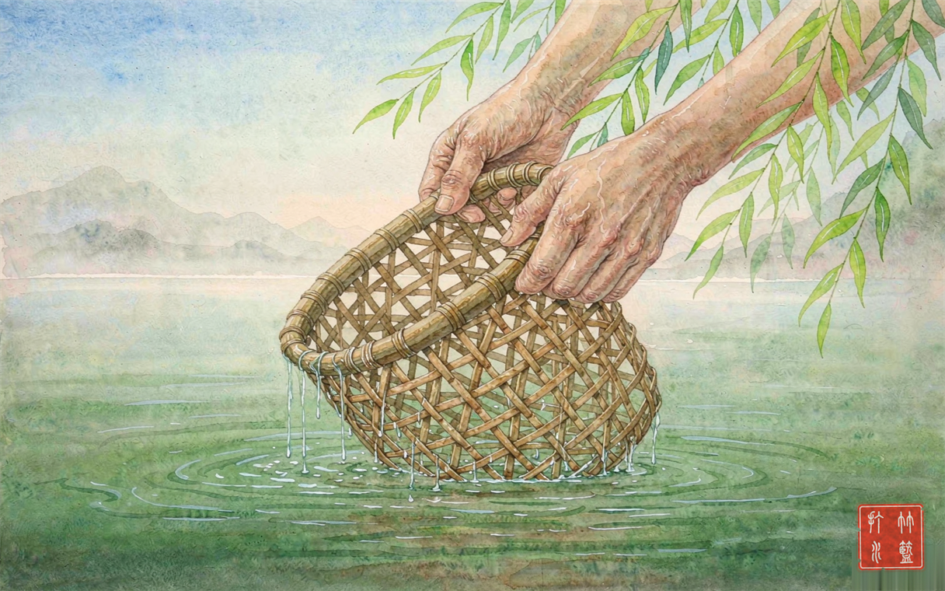
English, when it wants to describe effort that cannot possibly pay off, sends you to carry water in a sieve. Chinese, with better hardware available, hands you a bamboo basket instead. The saying runs:
竹篮打水——一场空 Drawing water with a bamboo basket — one big emptiness.
— Chinese xiehouyu (translation ours)
That dash in the middle is not decoration. It is the hinge of an entire genre of Chinese folk saying.
The two-part joke called xiehouyu
This phrase belongs to a form called xiēhòuyǔ (歇后语) — often translated “allegorical saying” or, more honestly, “the two-part Chinese joke.” The first half paints a little scene; the second half delivers the point, and in speech it is frequently left unsaid, the way English speakers can stop at “you know what they say about people who live in glass houses.”
So 竹篮打水 sets the picture — someone lowers a bamboo basket into a river to draw water — and 一场空 (yī chǎng kōng, “one scene of emptiness”) is the punchline: everything leaks out on the way up, and you haul in exactly nothing. A common variant swaps the ending for 枉费心机 (wǎngfèi xīnjī, ” scheming in vain”). Either way, the logic is the same: real effort, real labor, wrong container, zero result.
Chinese children learn xiehouyu in school the way American children learn knock-knock jokes — dozens of them, as a game. This one is among the oldest and most used.
Why bamboo, specifically
The image works because everyone who grew up south of the Yangtze knew the object. Bamboo grows fast, costs almost nothing, bends without breaking, and in village hands becomes baskets, cages, mats, poles, and fish traps. It is the defining “everyman material” of traditional Chinese daily life.
But woven bamboo has one honest limitation: it holds shape, not water. A basket can carry firewood, fruit, or a chicken across the whole county. Ask it to carry water and its finest quality — the gaps between the strips — becomes total failure. That is what makes the metaphor so satisfying: the tool is not broken. The task is wrong for it. Much of what the saying mocks is exactly that — hard work done earnestly in a container that could never hold the result.
The moon in the water
Bamboo baskets and water have one more famous meeting in Chinese idiom, and it involves the moon. A Buddhist parable, carried from India inside the scriptures and retold in China for well over a thousand years, describes a troop of monkeys who see the moon reflected in a pool and, terrified it has fallen from the sky, link tails and reach down to scoop it out. The branch breaks, the monkeys get a soaking, and the moon is still in the sky. The parable gave Chinese two idioms at once: 水中捞月 (shuǐ zhōng lāo yuè, “scooping the moon from the water”) and the broader idea that chasing reflections wastes your arms and your night.
Buddhist teachers in China loved this image. Water-moon became their standard metaphor for the world as we usually hold it — vivid, beautiful, and not graspable. A full moon lying flat in a village pond is the same moon farmers toasted at the harvest festival, the subject of our complete guide to the Mid-Autumn Festival; the difference is that on festival night nobody is trying to fish it out. They just pour it a little wine.
Basket and moon, then, are cousins: one says your effort misses because the container is wrong, the other says the prize was never where you thought it was. Between them, Chinese folk wisdom covers most varieties of human frustration.
When to reach for it
The saying is gentle enough for everyday complaint:
- Cramming all night before an exam, without doing a single practice problem — 竹篮打水.
- A company sinking another year of money into a product nobody wants — 竹篮打水一场空.
- Comforting a friend who worked hard for something that fell through: said softly, the phrase carries sympathy, not mockery. It concedes the effort was real before conceding the result was zero.
That double concession is why it has lasted. The basket deserves credit for going into the water at all.
If you like the way Chinese sayings compress a whole picture into a few strokes — basket, river, nothing — there is a longer story behind that habit, in how Chinese writing itself grew from small pictures into an empire of ideas, told in our piece on oracle bone script.