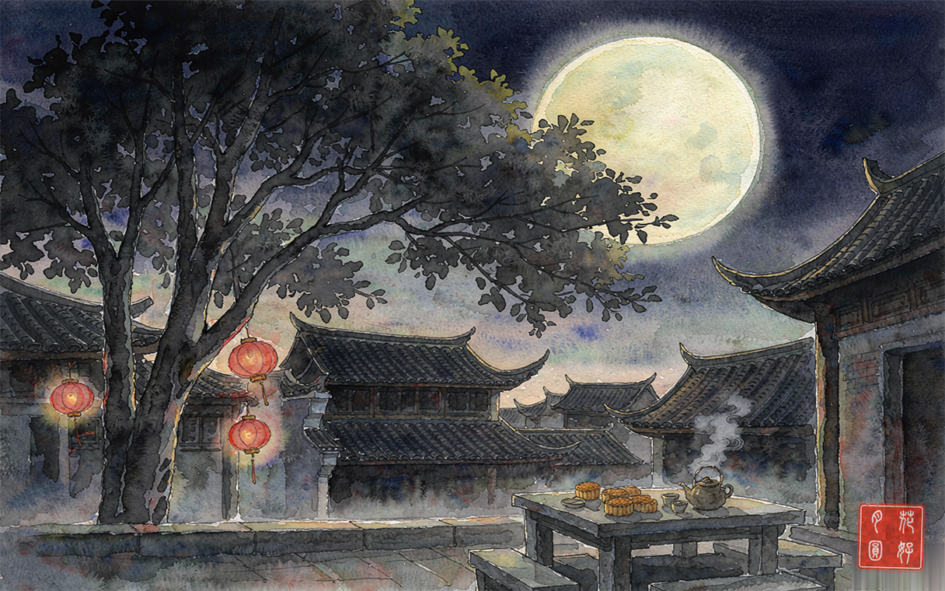
If you happen to look up on the evening of Friday, September 25, 2026, and the sky is clear, you will see the year’s most meaningful full moon — at least if you ask anyone in China.
That night is the Mid-Autumn Festival (Zhongqiu Jie, 中秋节), the second-most important holiday in the Chinese calendar after Lunar New Year. Trains will be packed. Bakeries will sell out of pastry by the tens of millions. Families will gather for dinner, carry lanterns through the streets, and end the night in the same way families in China have for a thousand years: by looking at the moon.
This guide explains what the festival is, where it came from, what mooncakes actually are, and how you can take part — even if the nearest Chinese bakery is an ocean away.
When is Mid-Autumn Festival 2026?
The Mid-Autumn Festival always falls on the 15th day of the 8th lunar month — the night of a full moon, chosen deliberately. In 2026, that is Friday, September 25.
Because the date follows the traditional lunar calendar, it drifts across our Gregorian calendar from year to year, usually landing somewhere between early September and early October. What never changes is the moon: the festival is fixed to the one night each lunar month when the moon is perfectly round.
Roundness is the whole point. In Chinese symbolism, a full circle means completeness and reunion (tuanyuan, 团圆). A family gathered under a full moon is the ideal image of the festival — which is why, for hundreds of millions of people, this is first and foremost a homecoming holiday.
One practical note for travelers: Mid-Autumn 2026 lands on a Friday, giving China a long weekend of its own — and it arrives just one week before the National Day “Golden Week” (October 1–7). If you are planning to visit China in autumn 2026, expect two consecutive weeks of heavy domestic travel.
A short history: from moon altars to mooncakes
The festival’s roots reach back nearly three thousand years, to the Zhou dynasty (c. 1046–256 BC), when kings held formal sacrifices to the moon each autumn. The Book of Rites records the pattern in a single balanced phrase: the king worships the sun in spring and the moon in autumn. The moon was honored as the yin force in the cosmos — the counterweight to the sun.
For a long time this remained a ritual for rulers. What turned it into a popular festival was the Tang dynasty (618–907), when moon-viewing became a fashionable pastime among poets and officials. Some of the most famous verses in Chinese literature were written on this exact night, wine cup in hand. By the Song dynasty (960–1279), Mid-Autumn had become a citywide celebration with night markets that stayed open until dawn, and by the Ming and Qing dynasties (1368–1912), the customs we recognize today — family reunion, moon altars, and above all the mooncake — were firmly in place.
In 2006, China added Mid-Autumn Festival to its first batch of national intangible cultural heritage; since 2008 it has been an official public holiday.
The legends behind the moon
Every Chinese festival carries its stories, and Mid-Autumn carries a constellation of them. The central figure is Chang’e (the Moon Goddess), whose flight to the moon is one of the oldest and most-loved tales in Chinese mythology. Depending on the version you hear, she swallowed an elixir of immortality to protect it from a thief — or simply out of curiosity, with consequences she regretted forever.
We tell her full story — and what China’s lunar space program has to do with a 2,000-year-old goddess — in Chang’e: The Goddess Who Lives on the Moon.
She is not alone up there. Legend places two more figures in the Moon Palace:
- The Jade Rabbit (Yutu), Chang’e’s companion, endlessly pounding the ingredients of the elixir of immortality with mortar and pestle. Look at the dark patches of the full moon and many people in East Asia see a rabbit, not the “man in the moon.”
- Wu Gang, a hapless woodcutter condemned to chop down a cassia tree that heals itself with every blow — eternity as a task that can never be finished.
Each full moon, in the Chinese telling, is a small household: a goddess, a rabbit, a woodcutter, and a tree.
Mooncakes 101: the most discussed pastry in China
The festival’s signature food is the mooncake (yuebing, 月饼): a dense, round pastry, traditionally filled and baked in a wooden mold that presses an ornate pattern into the top — flowers, characters for good fortune, or the name of the bakery.
The shape is symbolic. A mooncake echoes the full moon, and its roundness repeats the theme of reunion. Traditionally a mooncake is not eaten alone: a family cake is cut into equal wedges, one per family member — including relatives who could not make it home. The cake stands in for the family circle itself.
The classic fillings:
- Lotus seed paste — smooth, sweet, golden; the refined default of Cantonese-style mooncakes.
- Red bean paste — sweeter and earthier, a close second in popularity.
- Salted duck egg yolk — often set in the center of a sweet filling, a rich, salty echo of the moon itself. Premium versions contain two or more yolks.
- Five kernels (wuren) — a chewy mix of nuts and seeds (walnut, almond, melon seed, sesame, peanut). Famously divisive: the running joke in China every September is whether wuren is a delicacy or a punishment.
- Jujube (red date) paste and mung bean paste — older, homestyle fillings.
Regional styles matter as much as fillings. Cantonese mooncakes are the glossy, dark-gold standard most people picture. Suzhou-style ones are flaky and layered like puff pastry. Yunnan-style ones are stuffed with ham and honey — sweet, salty, and porky. In the last few decades, refrigerated snow-skin mooncakes (a chilled, non-baked wrapper) have taken over the young market, and every year brings novelty flavors from ice cream to durian to crayfish, mostly as gifts and conversation pieces rather than breakfast.
A note for first-timers: mooncakes are rich. The traditional move is to cut one into thin wedges and share it with tea, not to eat two in a row. Which brings us to —
How the festival is actually celebrated
The rhythms of a modern Mid-Autumn night in China:
- The reunion dinner. Wherever possible, the family gathers — this is the festival’s emotional core, and the reason the highways and trains are jammed. Overseas Chinese communities keep the same custom; in much of Southeast Asia (Malaysia, Singapore, Vietnam’s Tết Trung Thu, Korea’s Chuseok) related festivals fill the same week.
- Moon-viewing (shangyue, 赏月). After dinner, everyone moves to a balcony, rooftop, or park to look at the moon. It sounds like nothing. In practice, with tea, fruit, and mooncakes, it can go on for hours.
- Offerings to the moon. In many households, especially in southern China, a small table is set facing the moon with mooncakes, pomelos, and osmanthus wine — a quiet nod to the old ritual tradition.
- Lanterns. Children carry paper or electronic lanterns; in some southern cities, parks fill with glowing displays. Hong Kong’s Tai Hang district runs its famous Fire Dragon Dance, a serpentine dragon of burning incense sticks paraded through the streets.
- Osmanthus season. Mid-Autumn coincides with the bloom of the osmanthus tree, and its tiny golden flowers perfume the whole festival — in the wine, in the desserts, in the evening air.
- Poetry. Schoolchildren recite the classics for the occasion. The most famous is Su Shi’s Song-dynasty ode to the mid-autumn moon, written in 1076 while missing his brother, which ends: “May we live long; though a thousand miles apart, we share the same graceful moon.” (translation ours)
How to take part, wherever you are
You do not need a plane ticket. The festival scales down beautifully:
- Find a mooncake. Any Chinese bakery or well-stocked Asian supermarket will carry them in September. Cut it small, share it, brew strong tea alongside — pu-erh or oolong stands up to the sweetness best.
- Greet someone. The festival greeting is simple: Zhongqiu kuaile (中秋节快乐) — “Happy Mid-Autumn Festival.” Any Chinese-speaking friend or colleague will be genuinely pleased you knew.
- Keep a date with the moon. On the night of September 25, step outside and look up. If it is clear, you will be seeing the same moon as — simultaneously — a billion other people. That shared glance, across every time zone where the Chinese diaspora lives, is the oldest and least complicated part of the festival.
- Read the story. Start with the legend of Chang’e — it takes ten minutes and explains most of the imagery you will see on mooncake boxes.
Quick facts
| Date 2026 | Friday, September 25 (15th day, 8th lunar month) |
| Also called | Moon Festival, Mooncake Festival, Reunion Festival |
| Status | Public holiday in China; widely celebrated across East and Southeast Asia |
| Signature food | Mooncake (yuebing) |
| Core symbols | Full moon, roundness, reunion, the rabbit in the moon |
| Heritage status | China national intangible cultural heritage (2006) |
This article introduces Mid-Autumn Festival traditions as cultural and historical heritage, written with respect for living traditions.