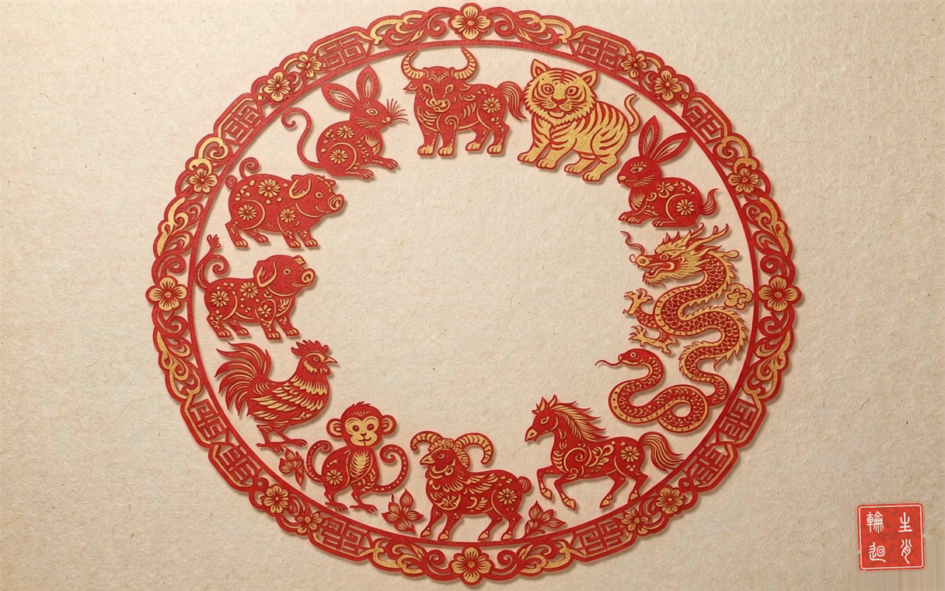
In the West, “what’s your sign” is a question about the month you were born. In China, the equivalent question is about an animal — and it is one of the most elegantly useful questions in everyday conversation. Ask someone their shengxiao (the Chinese zodiac animal) and you have politely asked their age, opened a conversation about personality, and located them on a twelve-year clock that has been running for roughly two thousand years.
It looks like a horoscope. But calling it one misses most of what the system is and does. The Chinese zodiac is closer to a shared calendar, a social shorthand, and a family of folk customs that still quietly shapes real decisions — including what color underwear you are supposed to wear in certain years.
Twelve animals, twelve years
The line-up is fixed and worth knowing on sight: Rat, Ox, Tiger, Rabbit, Dragon, Snake, Horse, Goat, Monkey, Rooster, Dog, Pig. Each animal governs one year; the cycle repeats every twelve years. Anyone can do the arithmetic: if you know someone’s animal and the current year’s animal, you know their age to within twelve — and most Chinese speakers do this arithmetic instantly, in their heads, all the time.
One catch trips up every newcomer: the zodiac year does not start on January 1. It starts at Chinese New Year, which falls somewhere between late January and late February. So a person born in January 2026, before the new year arrived, is not a Horse at all — they belong to the previous animal, the Snake. Half of the confusion Westerners have with the zodiac comes from forgetting that the whole system runs on a lunar calendar, not the civil one.
Right now the wheel sits on the Horse, an animal prized for energy and restlessness — which brings its own set of jokes about the personalities of people born in Horse years.
The machinery underneath: stems, branches, and sixty
The friendly animals are actually the decorative face of a serious calendrical machine. Underneath them runs the gan-zhi system: ten “heavenly stems” paired with twelve “earthly branches,” clicked forward together like two meshing gears. The branches carry the animals; the stems add a second layer. Running both at once produces a grand cycle of sixty years before the combination repeats — the famous jiazi cycle, which traditionally marked the length of a full adult life.
This machinery is old enough to be carved in bone. The stems and branches appear on oracle bones three thousand years ago — the earliest substantial Chinese writing, which we walked through in our piece on oracle bone script — where they were used to name days, long before anyone attached animals to years. The zodiac, in other words, is a popular skin stretched over one of the world’s oldest running calendars.
The system even keeps time within a single day: each animal rules a two-hour block, so the hours between eleven at night and one in the morning belong to the Rat — the animal’s own working shift, in a cosmos where everything has a shift.
Why these twelve, in this order
Ask why the rat leads the list and you will get the best-known animal story in China: the Great Race. The Jade Emperor, so the tale goes, announced a race to fix the order of the years. The rat, too small to swim the river, hitched a ride on the kind ox’s back — and just before the shore, leapt off the ox’s head and darted to first place. The ox took second and has been described as honest and hardworking ever since, with an air of someone who suspects the rat owes it an apology. Tiger swam in third; the dragon, astonishingly, came in fifth because it stopped mid-race to bring rain to a drought-stricken village — very on-brand for a creature that governs the rivers and the rainfall, and one that even turns up, name and all, among the oldest Chinese writing ever carved.
The cat, in most versions, was cheated by the rat — told the wrong date for the race — and that is why there is no cat in the zodiac and why cats chase rats to this day. The story travels: in Vietnam, centuries of borrowed calendar and local taste swapped the rabbit for a cat, so the Vietnamese zodiac has no Rabbit year at all. Same machine, different fauna — proof that the zodiac is a living folk tradition, not a fixed scripture.
What people actually do with it
Here is where the zodiac parts ways with a newspaper horoscope: almost nobody in China reads it for a daily prediction. Instead it runs through ordinary life as custom and courtesy.
It is a polite age question. Asking a person’s animal is a graceful way to place them generationally without asking their age outright. It is a matchmaking filter — traditional matchmakers checked animal compatibility before anything else, and some couples’ parents still do the arithmetic, however half-jokingly. It is a birth-timing consideration: hospitals in China reliably report baby booms in Dragon years, when families aim to have a child under the most prestigious animal of the twelve. And every twelve years comes your ben ming nian — your own animal’s year — which tradition treats as a year of unstable luck, to be armored against by wearing something red: a red belt, red socks, or, famously, red underwear. On ben ming nian mornings in any Chinese city, someone is unwrapping exactly that gift.
None of this is doctrine. It is a folk system doing what folk systems do best: giving people a shared vocabulary — for time, for age, for personality, for luck — that everyone can use and nobody has to take too seriously.
A rabbit that also lives on the moon
The zodiac’s Rabbit shares an identity with a bigger mythological celebrity: the rabbit in the moon, pounding the elixir of immortality beside the goddess Chang’e. When people list the Rabbit’s virtues — gentleness, alertness, a touch of mystery — part of what they are invoking is that lunar pedigree. The rabbit is the only zodiac animal with a second residence in the sky, which is one reason the Mid-Autumn Festival is full of rabbit-shaped lanterns and rabbit-faced mooncakes, and why China named a lunar rover Yutu, the Jade Rabbit.
That is the pattern worth taking away. The zodiac animals are not locked in a chart; they wander freely through the rest of the mythology, picking up stories and lending them back.
Keep reading: Chang’e: The Goddess Who Lives on the Moon tells the rabbit’s lunar story in full, and the history of the mooncake explains the pastry that carries the festival — and the rabbit — to every dinner table.