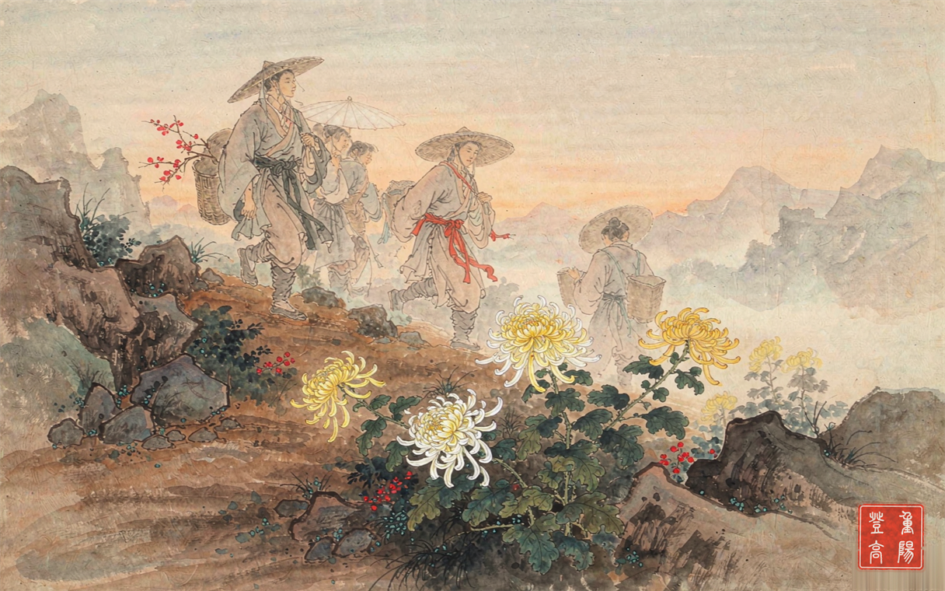
The Chinese calendar hides a strange arithmetic in its festivals. Twice a year, the month and the day land on the same number, and whenever that happens, the date becomes a festival. The seventh day of the seventh month gives us the Qixi love story that we covered in a piece on the festival itself. The ninth day of the ninth month gives us Chongyang — and Chongyang comes with the most thriller-like origin story of them all: a plague demon, a warning from a fortune-teller, and a young man who saved his whole village by taking them up a mountain.
The festival falls in mid-October by the solar calendar, which this year means October 18. If you happen to be near any hill in China on that day, you will see a slow parade of people climbing it. The legend explains why.
The legend of Huan Jing
The story comes from a book of strange tales compiled nearly two thousand years ago, and it runs like this. In the Eastern Han dynasty, there lived a young man named Huan Jing (Huan Jing is the pinyin rendering of 桓景), in a village near the Ru River. A plague demon stalked the region, and every year it came out and took lives. Huan Jing’s own parents had died of it. Grieving and angry, he set out to find a famous sorcerer named Fei Changfang, who was said to have real power over such things.
Fei Changfang took him in and taught him — the tale specifies a sword and the arts of subduing demons. One day the master gave his student a warning with a precise date attached: on the ninth day of the ninth month, the plague demon would strike Huan Jing’s village again. The countermeasure was a checklist. Each villager should be given a small red pouch of zhuyu (the cornel or dogwood plant, zhuyu) to wear, a cup of chrysanthemum wine to drink, and then everyone should climb the nearest mountain with the whole household and wait there until evening.
Huan Jing led his village up the hill with the pouches and the wine, as instructed. When they came down at dusk, they found disaster at home — in the most common version of the tale, the livestock and poultry were all dead. The demon had come, found no humans to take, and vented itself on the animals instead. Every person who had climbed the mountain was untouched.
From that day, the story concludes, the customs of the ninth day of the ninth month spread across the land: wear the dogwood, drink the chrysanthemum, climb the high place. A catastrophe averted became an annual appointment.
Why the double nine matters
A skeptic will note that the legend reads like an invented explanation for customs that already existed — and that is very likely what it is. The deeper logic sits in the number itself.
In Chinese cosmology, numbers divide into yin and yang: even numbers are yin, odd numbers are yang, and nine is the extreme of yang — the largest single digit, the number of the emperor and the azure sky. The ninth day of the ninth month is therefore a “double yang” day, Chongyang (Chongyang means exactly “double yang”). But extreme yang was also thought to carry danger: a peak is a turning point, and a day of maximum yang could tip over into misfortune. The customs all read naturally as protective moves — sharp-scented dogwood to repel harm, wine to purify, and the high ground of a mountaintop as the safest vantage. Whatever one makes of the cosmology, the result is a festival about actively seeking height and fresh air at the moment autumn turns cold.
A poem every schoolchild knows
No Chinese person meets Chongyang for the first time as an adult. They meet it in childhood, through a Tang-dynasty poem written by Wang Wei, who was seventeen and homesick when he wrote it:
Alone in a strange land, a stranger — on every festival I think of my kin twice over. Far away I know my brothers have climbed the heights, wearing dogwood sprigs — and one of us is missing.
— Wang Wei, “On the Ninth Day of the Ninth Month, Remembering My Brothers East of the Mountain” (translation ours)
The poem does something quiet and clever: it is not about the festival but about an absence at the festival. A line of climbers, each with a dogwood sprig, one person short. That image — family ritual with a gap in it — has carried Chongyang’s mood of autumn remembrance into the present.
Chrysanthemums, cake, and the long life
Chongyang is also the festival of the chrysanthemum, the flower that blooms precisely when everything else is fading, and in old China that made it a symbol of endurance. Drinking chrysanthemum wine and admiring the late blossoms were the refined pleasures of the day; poets retired to chrysanthemum gardens the way they retired to the mountains. Families also steam Chongyang cake — a layered pastry whose name, gao, is a pun on the word for “high,” so that eating a slice of cake is a way of climbing the mountain by other means, and a spoken wish that the family rise higher year by year.
The festival’s other name tells you where it went in the modern era. Because nine sounds like the word for “long-lasting” (jiu), the double ninth became a wish for longevity — and in recent decades Chongyang has been reimagined around the elderly. It is now known as Senior Citizens’ Day: adult children visit their parents, communities hold banquets for elders, schools organize children to honor grandparents. A legend about escaping a demon has become a day about giving the oldest people in your life the best seat — ideally on a mountaintop, if their knees permit.
The ninth-month moon overhead is the same moon of the festival cycle we have written about often. For the fuller context of how China’s festival calendar pairs mythology with the night sky, start with the Mid-Autumn Festival guide, and for the moon’s most famous resident, the story of Chang’e picks up where the lanterns leave off.
Keep reading: The Mid-Autumn Festival guide covers the season when moon mythology peaks, and Qixi, the original Chinese love story shows what the calendar’s other double-number day turned into.