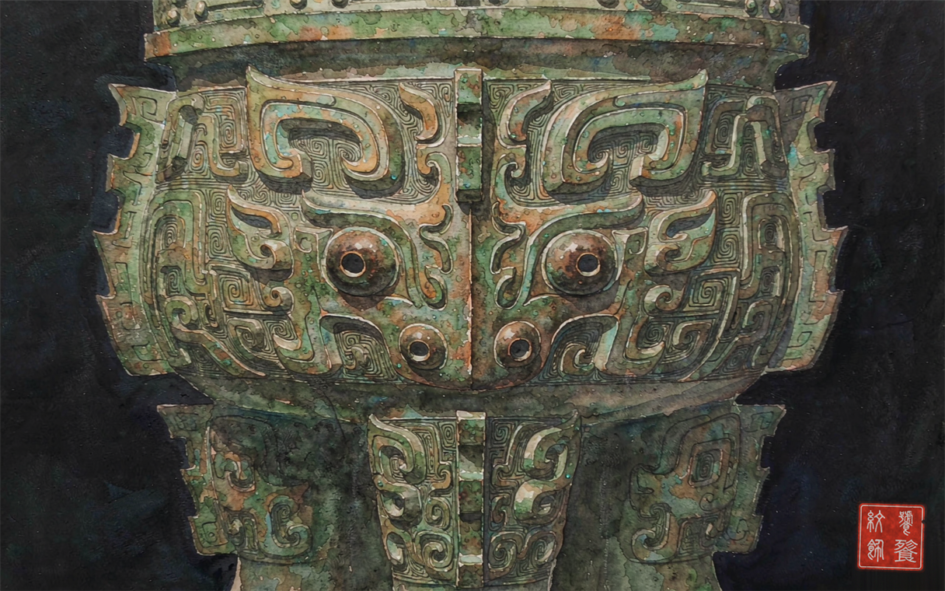
Walk into the bronze gallery of any major Chinese museum and you will feel it before you can name it: rows of three-thousand-year-old ritual vessels, every surface crawling with spirals and ridges, and out of the pattern — two enormous eyes. Round, bulging, symmetrical eyes, flanked by curled horns and jaws, staring out from a face that never quite resolves into any real animal. Ancient Chinese bronzesmiths put this monster on thousands of vessels and never left a single line explaining it. Later generations gave the face a name and a biography: they called it the Taotie (Taotie is the pinyin rendering of 饕餮), and they said it was the greediest creature that ever lived.
The face that eats the pot
The vessels themselves were the high technology of the Shang dynasty (roughly 1600–1046 BC) and the Zhou dynasty that followed — cast bronze cauldrons called ding, wine containers, water basins, made to hold food and drink offered to ancestors. This is worth dwelling on, because it makes the placement strange: the monster does not decorate weapons or palace walls. It covers the dishes on which living families presented meals to their dead. Whatever the taotie was, it belonged at the table between the worlds.
The motif is a mask — modern archaeologists often call it simply the “animal mask” (shoumian) design — built from symmetrical halves: a pair of eyes, C-shaped horns, a jaw with teeth, a body that splits and coils away on both sides until it dissolves into cloud-and-thunder spirals. On some vessels the animal is recognizable, something like a water buffalo or a tiger. On many more, it is nothing in the zoological record at all.
The era that produced these bronzes also produced China’s earliest writing, carved on bone for divination — the world we described in our piece on oracle bone script. Yet the oracle bones, for all their thousands of questions about harvests, rain, and ancestor sacrifices, never mention a creature named taotie. The monster’s name arrives centuries after the monster’s face.
What the later texts say
The name shows up in texts from the Eastern Zhou period, and they are not kind. A passage in the Lüshi Chunqiu, a compendium assembled around 239 BC, offers the image that defined the creature ever after:
On the Zhou ding they depicted the taotie: it has a head but no body. It ate a man before it could swallow, and the harm fell upon its own body. This is to show that virtue is repaid and that those who do wrong meet calamity.
— Lüshi Chunqiu, “Xian shi lan” (translation ours)
A head without a body; a mouth that destroyed itself by feeding. Later catalogs swelled the legend: the Classic of Mountains and Seas describes a man-eating monster with a sheep’s body, a human face, tiger teeth, and eyes under its armpits, and later readers connected it to the taotie — one identification among several, and no one can prove which is original. The Ming-dynasty Journey to the West even gives a giant gluttonous beast the name, centuries down the line.
The most consequential piece of late lore makes the taotie one of the Four Perils — four monstrous beings said to have rampaged in the age of legendary emperors until a righteous ruler banished them to the frontier, where they were supposed to repel worse spirits. The four appear in different lists under different names, another case where tradition itself disagrees with tradition; but the taotie’s seat in the lineup — the greedy one — never changes.
Why put a monster on a sacred pot?
So why would the most ritual-obsessed civilization in the ancient world stamp a man-eating glutton on its holiest tableware? Nobody knows, and this is exactly what keeps scholars writing about it. The serious candidates:
- It keeps worse things away. A face fierce enough to frighten people may have been chosen precisely because it frightens spirits — an ancient security system in bronze.
- It is a middleman. The Shang spoke with ancestors through sacrifice; a hybrid, impossible creature might have been the go-between, its stare fixed on the spirit world while people looked at its back.
- It is a warning. The Eastern Zhou texts read the mask as a moral: appetite without limits consumes itself. On this reading, the monster on the pot told everyone at the ritual feast not to become one.
The theories are not mutually exclusive, and honest museum labels usually say “perhaps” more than once. What is certain is the craftsmanship: pieces cast in sections so precisely that the seams of the mold vanish into the design, as if the monster had grown there naturally.
From bronze to the dinner table
The creature’s afterlife is one of the best demonstrations of how a monster becomes a word. The name taotie entered everyday Chinese as a noun for a glutton, and — by a friendlier turn — for a devoted eater: modern menus and food writers borrow the beast for phrases like “a taotie feast,” meaning a spread so lavish it would tempt the legendary monster itself. A face that once glared from sacrificial bronze now glares, in cartoon form, from restaurant signs and snack packaging.
That journey — sacred, forgotten, moralized, domesticated — is very Chinese, and it rhymes with how the culture treats food generally: eating is never just eating. To see what grew on the ordinary side of the table, Chinese Tea 101 traces how a drink became a social institution over the same long centuries the taotie was staring out from bronze.
Keep reading: Oracle bone script tells how writing began in the same Shang world that cast these vessels, and Chinese Tea 101 follows the gentler side of the Chinese table.