The Short Version: All Chinese tea comes from one plant — Camellia sinensis. The six main types (green, white, yellow, oolong, black, dark) differ mainly in how the leaves are processed, especially how much they are oxidized and whether they undergo microbial fermentation. Drink the right tea at the right time, brew it the way the Chinese do — small pot, short steeps, many infusions — and you unlock a different kind of flavor than anything you can get from a tea bag.
Here’s a fact that surprises almost every Western tea drinker: the green tea you sip for antioxidants, the oolong your friend orders at a dim sum restaurant, the Earl Grey in your kitchen cupboard, and the earthy pu’er sold for hundreds of dollars a cake — they all come from the same plant. Camellia sinensis. A single species. What makes them different is what happens to the leaves after they are picked.
1. The Six Types — Sorted by Oxidation
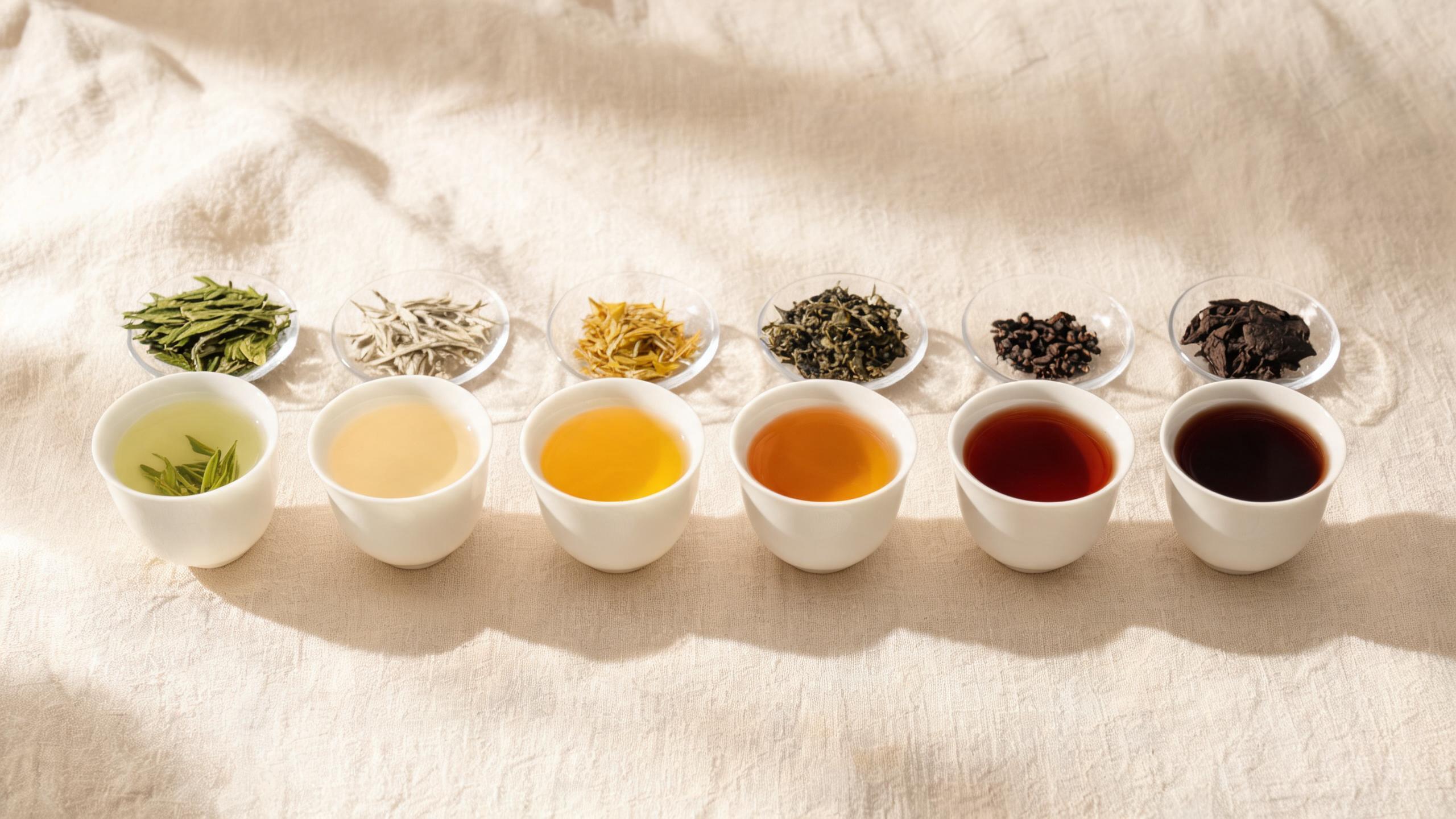
Think of Chinese tea as a spectrum, not a category list. The main axis is oxidation — what happens when the enzymes inside a freshly picked leaf meet oxygen in the air.
- Green tea (绿茶, lǜchá) — Unoxidized. The leaves are heated (pan-fired or steamed) right after picking, killing the enzymes. The result: a fresh, vegetal, sometimes grassy or nutty flavor. Famous examples: Longjing (Dragon Well) from Hangzhou, Biluochun from Jiangsu, Huangshan Maofeng from Anhui.
- White tea (白茶, báichá) — Minimally oxidized (5–10%). Leaves are simply withered in the sun and dried. The flavor is delicate, sweet, slightly floral. Famous examples: Silver Needle (Baihao Yinzhen), White Peony (Bai Mudan).
- Yellow tea (黄茶, huángchá) — Lightly oxidized and “sealed yellowed” (闷黄). Similar to green tea, but the heated leaves are wrapped in cloth and gently re-heated, producing a mellower, sweeter taste. Famous example: Junshan Yinzhen from Hunan.
- Oolong tea (青茶, qīngchá) — Partially oxidized (30–70%). The leaves are bruised to start oxidation, then heated to stop it at the desired level. Flavor ranges from light and floral (Tieguanyin) to dark and roasted (Da Hong Pao). Famous examples: Anxi Tieguanyin, Wuyi Rock Tea, Dong Ding.
- Black tea (红茶, hóngchá) — Fully oxidized. All the way. The leaves turn coppery-brown. This is what the West calls “black tea” — and what the Chinese call red tea, because of the color of the brewed liquid. Famous examples: Keemun (Qimen), Lapsang Souchong, Dianhong (Yunnan Red).
- Dark tea / Pu’er (黑茶, hēichá) — Post-fermented. After processing, the tea undergoes microbial fermentation, sometimes for years. The flavor becomes deep, earthy, smooth — sometimes compared to damp forest floor or old wood. Famous examples: Liu Bao, Liu An, and the most famous of all: Pu’er from Yunnan, often pressed into round cakes.
Notice the color in the photo above. As oxidation increases, the brewed tea goes from pale green to deep gold to amber to dark red. Same plant, six expressions.
Why This Matters: When you read “Chinese black tea,” you now know to ask: do they mean what the West calls black (which is 红茶 in Chinese), or do they mean what the Chinese call “dark tea” (黑茶, like pu’er)? These are completely different products, but the English word “black” can refer to either. The translation gap has confused buyers for centuries.
2. The Translation Trap: “Red Tea” vs “Black Tea” vs “Dark Tea”
This is the part that trips up most Western tea drinkers — and many Western tea companies.
When Dutch and British traders first imported fully-oxidized Chinese tea in the 17th century, they looked at the dry leaves — which had turned black during oxidation — and called it “black tea.” The Chinese, looking at the brewed liquid, called it “red tea” (红茶, hóngchá) because of its reddish color.
Both terms are still in use today. The English-speaking world says “black tea” for what the Chinese call red. The Chinese say “red tea” for what English speakers call black. This is the most famous translation trap in the tea world.
Then there’s the second trap. The Chinese “black tea” (黑茶, hēichá) is NOT the same as what the West calls “black tea.” 黑茶 refers to a different category entirely: post-fermented teas like pu’er, which are often dark in color and aged for years. Westerners often call this “dark tea” or “pu’er” to avoid the confusion. Smart companies use the Chinese pinyin “pǔěr” on their packaging.
If you remember nothing else: red tea in Chinese = black tea in English. They are the same thing. Black tea in Chinese ≠ black tea in English.
3. Gongfu Tea: Why the Tiny Teapot?
If you have ever seen a Chinese tea setup, you probably noticed something strange. The teapot is tiny — maybe 100ml. The cups are even tinier — 30ml or less. And you keep refilling the pot, over and over, seven or eight times, into the same cups. This is called gongfu cha (功夫茶) — literally “tea made with skill.”
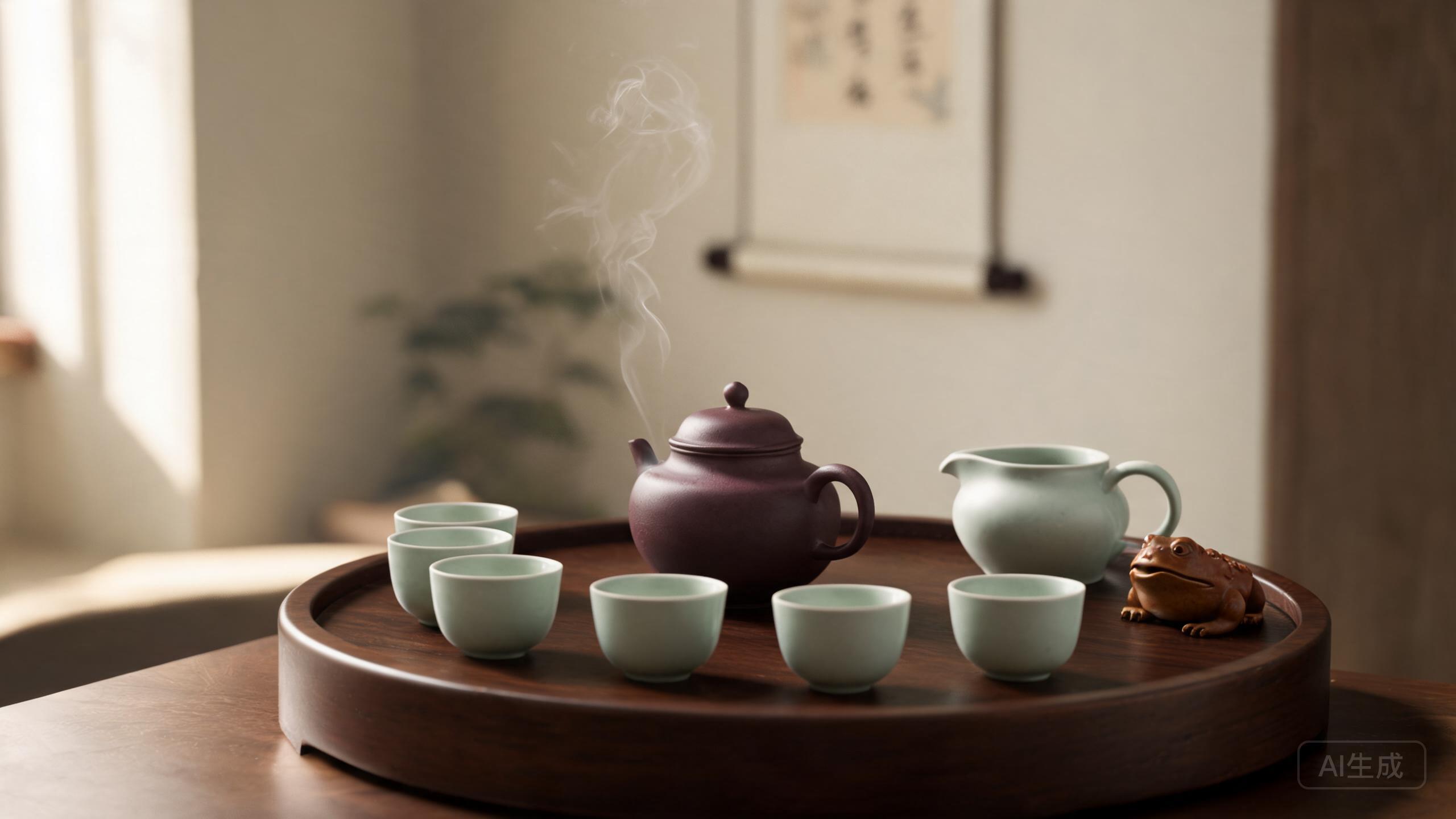
Why so small? Because the goal is not to make a big cup of tea. The goal is to taste the evolution of a tea leaf over many steepings. Here’s how it works:
- Hot water goes into the pot.
- Five seconds later, it goes out — into a small pitcher called the gongdaobei (公道杯) or “fairness pitcher.”
- The pitcher distributes the tea evenly into all the tiny cups.
- You drink the first steep. It tastes one way — light, floral, maybe.
- You add more hot water. Wait ten seconds this time. Drink. It tastes different — deeper, rounder.
- You do this seven, eight, twelve times. Each steep reveals a new layer of flavor.
Compare this to the Western way: one big mug, one teabag, hot water, leave it for three minutes, drink. You get one flavor profile, once. Gongfu gets you twelve.
The tiny teapot isn’t a quirk. It’s a precision instrument for extracting flavor in layers.
The Point of Gongfu: It’s not about caffeine. It’s not about getting a stronger cup. It’s about tasting the same tea at twelve different moments in its life — and noticing how it changes. Most Chinese tea enthusiasts will say the first three steepings of a good oolong are completely different drinks, even though they came from the same leaves in the same pot.
4. 5,000 Years in Three Minutes
Chinese legend says Emperor Shennong — the mythical “Divine Farmer” who taught China agriculture — accidentally discovered tea around 2737 BCE. A leaf fell into his boiling water. He tasted it. It refreshed him. Tea was born.
The historical timeline is more grounded but no less impressive:
- Tang Dynasty (618–907 CE): Tea becomes China’s national drink. Lu Yu writes The Classic of Tea (茶经) — the world’s first monograph on tea. It is still in print.
- Song Dynasty (960–1279): The tea-whisk ceremony emerges. Powdered tea is whisked in bowls, similar to the Japanese matcha ceremony that would later descend from it.
- Ming Dynasty (1368–1644): The emperor bans tribute powdered tea. Loose-leaf steeping — the method we use today — becomes standard. The small teapot and the gongfu method follow.
- 1600s: The Dutch East India Company begins shipping Chinese tea to Europe. By 1700, Britain is hooked. The tea trade is one of the largest in world history.
- 1773: The Boston Tea Party. American colonies dump British East India Company tea into Boston Harbor. The American Revolution follows three years later. Tea helped start a country.
- 1840s: The First Opium War is fought — in part — over Britain’s attempt to balance its massive tea import bill by selling opium to China. Tea also helped end an empire.
Five thousand years. From an accidental leaf-drop to a global commodity to a revolutionary act.
5. How to Start Drinking Chinese Tea
If all of this is new to you, here’s a simple starting path.
Begin with oolong. A medium-roast Tieguanyin or a basic Wuyi rock tea is forgiving, fragrant, and complex without being extreme. Buy a small tin (50–100g is enough to try). Avoid anything labeled “oolong tea bag” — those are usually low-grade.
Skip the teabag and use a small pot. A 100–150ml porcelain teapot or a Yixing purple-clay pot if you want to invest. Pair with 30–50ml cups. This forces the gongfu method, and gongfu is where Chinese tea shines.
Steep short, steep often. First steep: 10 seconds. Second: 15. Third: 20. Beyond the fifth steep, add 5–10 seconds each time. A good oolong will give you 7–10 good steepings. A good pu’er might give you 20.
Use water that is hot but not boiling. For green and white teas, around 75–85°C (170–185°F). For oolong, 90–95°C (195–205°F). For black and pu’er, full boil. Boiling water on green tea burns the leaves and creates bitterness.
Don’t add anything. No milk. No sugar. No lemon. Chinese tea is meant to be tasted on its own. The first time you try a good oolong without anything added, you’ll understand why.
Coming Soon: The Tea Collection
We’re designing a collection of small-batch gongfu tea sets and pu’er cake displays — Yixing-inspired purple-clay pieces paired with celadon cups on dark bamboo trays, built around the same six-type color spectrum above. Stay tuned.
Keep Reading
- Oracle Bone Script: How the Chinese Wrote 3,000 Years Ago — The earliest writing system, and how a malaria patient found it in a medicine shop. Published
- One Character, One Culture: Understanding Zen (禅) — From Indian Buddhism to Japanese aesthetics, one character’s 1,500-year journey. Coming soon
- Chinese Calligraphy: Why Writing Is an Art Form — The four treasures of the study and five major scripts. Coming soon
The tea history summarized above draws on Lu Yu’s Classic of Tea (Tang Dynasty, 8th century) and modern scholarship on Chinese tea classification — both in the public domain.