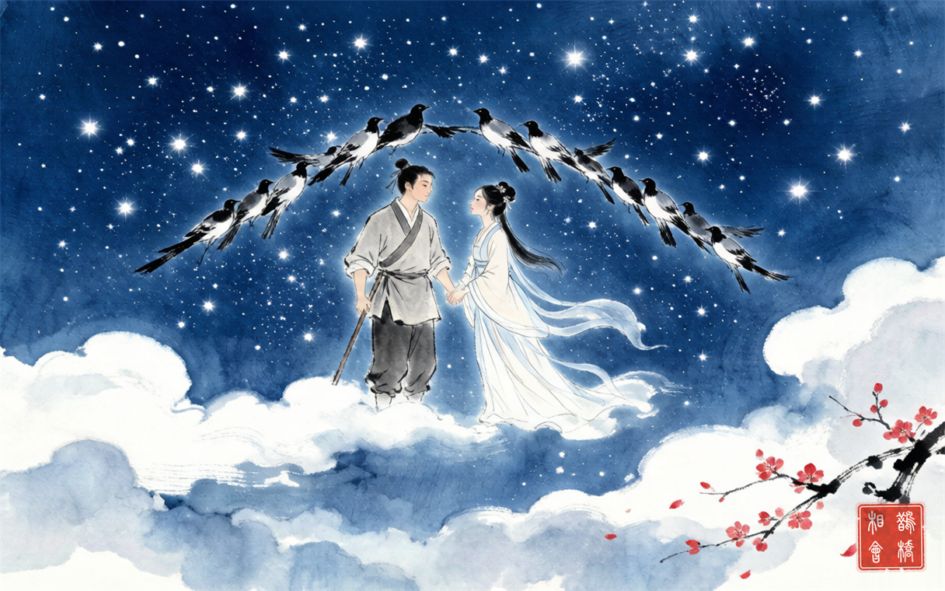
The Short Version: Qixi Festival (七夕) falls on the 7th day of the 7th lunar month. It started as a story about two stars — Vega and Altair — separated by the Milky Way. Over 2,000 years, it evolved from a stargazing myth into a festival where women prayed for skill in needlework. Only in the 21st century did it become \"Chinese Valentine\'s Day.\" The holiday you see today is barely 20 years old. The story behind it is older than Christianity.
Qixi doesn\'t begin on Earth. It begins in the sky.
Go outside on a clear summer night in the Northern Hemisphere. Find the Milky Way — that pale band of light arching across the sky. On one side of it, you\'ll see a brilliant blue-white star. That\'s Vega — the fifth-brightest star in the night sky. On the other side, a little dimmer, is Altair. Between them runs the river of light we call the Milky Way.
Ancient Chinese astronomers gave these stars names that would shape 2,000 years of storytelling. Vega became Zhinü (织女), the Weaver Girl. Altair became Niulang (牛郎), the Cowherd. They named the Milky Way Tianhan (天汉) — the Heavenly River.
Two stars. One river. They can never touch.
From this simple astronomical fact, the Chinese imagination built one of the world\'s oldest love stories — a tale of separation, longing, and a single reunion night each year.
Why This Matters: Unlike most holidays that commemorate historical events or religious figures, Qixi is rooted in naked-eye astronomy. You can see the \"story\" with your own eyes, no telescope needed. This is probably why it has survived for 2,000 years — the sky never changes.
2,000 Years of Transformation
Here\'s the part most people don\'t know — including most Chinese people. Qixi wasn\'t always a love festival. It went through at least five distinct phases before becoming what it is today.
- Pre-Qin (before 221 BCE) — The Seeds: Just two stars, no story yet. China\'s oldest poetry collection, the Classic of Poetry (诗经), mentions both stars by name — but there\'s no love story. The poem uses them as metaphors for complaining: \"That Weaver Girl can\'t actually weave. That Cowherd can\'t actually pull a cart.\" They\'re just names attached to bright lights in the sky.
- Han Dynasty (206 BCE – 220 CE) — The Story Is Born: A poem from the Nineteen Old Poems (古诗十九首) — an anonymous collection from around the 1st or 2nd century CE — gives us the first complete version of the love story. The Weaver Girl sits at her loom by the Heavenly River, weeping because she can\'t cross to her Cowherd. Also during this period, the Han emperor Wu fixed the date: the 7th day of the 7th lunar month. Qixi now had a birthday.
- Southern & Northern Dynasties (420–589) — The Details: A scholar named Zong Lin wrote Jingchu Sui Shi Ji (荆楚岁时记), which gave us the story in its most familiar form: Zhinü was the Heavenly Emperor\'s daughter. She wove clouds at her loom on the east bank of the Milky Way. Niulang herded cattle on the west bank. The Emperor took pity on their separation and allowed them to meet once a year — on the 7th night of the 7th month. On that night, magpies form a bridge across the Milky Way so the lovers can cross.
- Tang & Song (618–1279) — The Golden Age: This is the most important turning point, and the one most people get wrong. In Tang and Song dynasty China, Qixi became a massive popular festival — but its heart wasn\'t romance. It was \"praying for skill\" (乞巧, qǐqiǎo). On the 7th night, women and girls set up tables under the stars, offered fruits and tea to Vega, and competed in needle-threading contests: who could thread a seven-hole needle fastest under moonlight? They floated needles on water and read the shadows as fortune-telling. This was a women\'s festival — closer to a skills-and-wishes night than a Valentine\'s Day.
- Ming–Qing to Modern (1368–2000) — The Long Decline: As textile production industrialized, \"praying for needlework skill\" lost its meaning. Why ask a star for weaving skills when machines do it better? Qixi didn\'t die — but it thinned out. In most regions, it survived only as a minor folk custom: eating \"skill cakes\" (巧果, qiǎoguǒ), drying books and clothes in the sun, or telling children the story of the cowherd and the weaver girl.
- 2000s–Present — The Rebrand: Here\'s the twist. In the early 2000s, Chinese retailers began rebranding Qixi as a \"Chinese Valentine\'s Day\" — a domestic answer to February 14. In 2006, the Chinese government listed Qixi on the first National Intangible Cultural Heritage register, giving it official backing. The rebrand worked. Today, most young Chinese people know Qixi primarily as a couples\' holiday — a day for flowers, dinners, and gifts. The 2,000-year-old festival for women wishing to become more skilled has become a 20-year-old shopping holiday.
The Key Distinction: Ancient Qixi and modern \"Chinese Valentine\'s Day\" share a date and a story — but almost nothing else. The ancient festival centered on one woman (the Weaver Girl), celebrated skill and craft, and was participated in mainly by women. The modern version centers on couples, celebrates consumption, and is participated in by anyone with a wallet. Same stars. Different holiday.
The Poem That Started It All
If you want to understand Qixi in one piece of writing, read this. It comes from the Nineteen Old Poems — an anonymous collection from around 1,900 years ago. This is the first time the Cowherd and Weaver Girl appear as lovers in Chinese literature.
I\'ve included the original Chinese alongside an English rendering. Even if you don\'t read Chinese, look at the characters — notice how the poem was designed to be felt, not just understood.
迢迢牵牛星 — \"Far, Far Away Shines the Cowherd\" (c. 1st–2nd century CE)
迢迢牵牛星,皎皎河汉女。
纤纤擢素手,札札弄机杼。
终日不成章,泣涕零如雨。
河汉清且浅,相去复几许。
盈盈一水间,脉脉不得语。Translation: Far away shines the Cowherd star. Bright is the Weaver Girl by the Heavenly River. She stretches her pale, delicate hands. Click-clack go the loom\'s shuttles. But she weaves no pattern all day — her tears fall like rain. The Heavenly River is clear and shallow. How far apart can they be? One shallow stream between them — eyes locked, she cannot speak.
Why it hits hard: The killing blow is in the last two lines. The river isn\'t deep. It isn\'t wide. It\'s \"clear and shallow.\" They can see each other. They just can\'t reach. This is not the agony of distance — it\'s the agony of proximity. And if you\'ve ever video-called someone you love and couldn\'t touch them, you know exactly what 1st-century China felt when they wrote this.
How to Actually Celebrate Qixi
So should you treat Qixi as Valentine\'s Day or as something older?
Both — but knowing the difference makes it better.
There\'s nothing wrong with celebrating Qixi as a couples\' holiday. The Cowherd and Weaver Girl are a love story. But if that\'s all you know, you\'re missing the most interesting part — the 1,000-year period when this night belonged to women, not to couples.
In Tang and Song dynasty China, the 7th night of the 7th month wasn\'t about buying gifts for your partner. It was about sitting under the stars with other women, competing in needle-threading contests, and asking Vega — not a man, not a god, but a star — to make you more skilled, more capable, more yourself.
That\'s a cooler origin story than \"chocolate companies needed another sales day.\"
Fun Fact: In Tang dynasty China, Qixi wasn\'t a single night — it was a multi-day event. Women started building \"wishing pavilions\" (乞巧楼) on the 6th, stayed up all night on the 7th, and the festivities continued into the morning of the 8th. Think of it as a 1,200-year-old girls\' sleepover under the stars — with competitive needle-threading.
The Real Gift of Qixi
Qixi started with stars. It became a story. The story became a festival. The festival became a shopping event. Two thousand years of transformation, layered on top of one simple astronomical fact: two bright stars, separated by a river of light.
Here\'s what I love about it: the stars are still there. Vega and Altair haven\'t moved. The Milky Way still flows between them. The story hasn\'t changed — only the people telling it have.
So this Qixi, instead of only buying flowers, try this: go outside after dark. Look up. Find the two brightest stars on either side of the Milky Way. They\'re doing what they\'ve always done — shining at each other across a river of light, year after year, century after century.
That\'s the real gift. A 2,000-year-old love story, playing in the sky every single night. You just have to look up.
Coming Soon: The Qixi Star Map Series
We\'re designing a collection of wall art and accessories inspired by that 2,000-year-old night sky — the Milky Way, the magpie bridge, Vega and Altair in minimal lines and deep indigo. If you\'d like to bring that sky home, stay tuned. The collection launches soon.
Keep Reading
- Mid-Autumn Festival: Why the Chinese See a Rabbit in the Moon — Qixi and Mid-Autumn share the same sky — and the same ancient impulse to find stories in the stars. Coming soon
- The 24 Solar Terms: How Ancient China Named Time — Qixi falls on the lunar calendar\'s 7th month, 7th day. But China had a completely separate timekeeping system — 24 solar terms — that\'s still in use today. Coming soon
- Chinese Mythology 101: From Pangu to Nezha — The Cowherd and Weaver Girl are just one corner of China\'s mythological universe. Here\'s the big picture — from creation myths to warrior gods. Coming soon
All referenced classical texts — the Classic of Poetry, Nineteen Old Poems, and Jingchu Sui Shi Ji — are in the public domain.