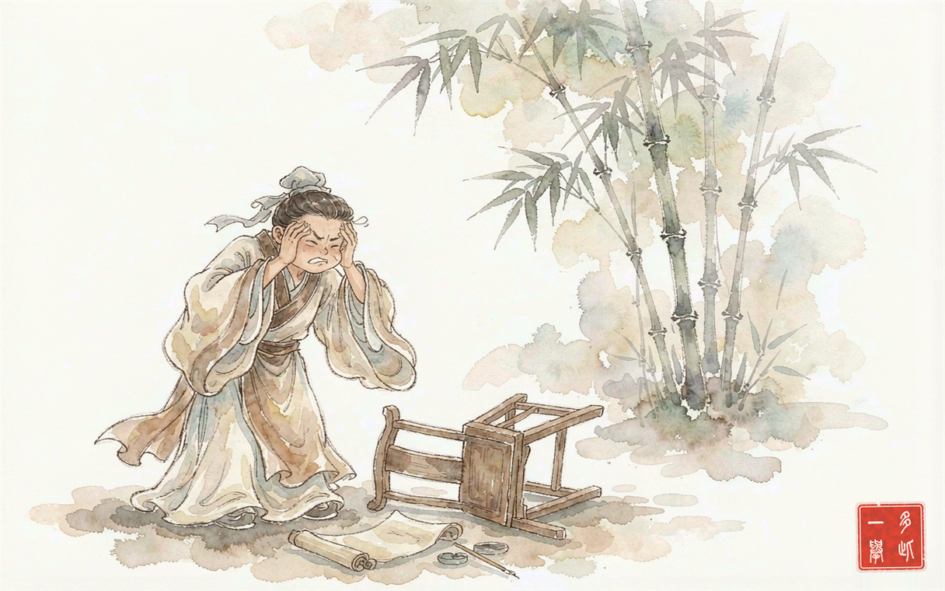
Every language keeps one phrase in the back drawer — too rude for the office, too accurate to delete. In Chinese, the drawer holds a masterpiece: tuō kùzi fàng pì (脱裤子放屁), taking off your pants to fart.
On its face, it is not even rude, just physics. The fart needs no assistance. Removing the pants adds effort, adds delay, adds risk, and changes nothing about the result. It is the perfect image for an action that is not merely useless but unnecessarily useless — a step that exists only to complicate a thing that was already simple.
The punchline half
Like many everyday sayings, this one often travels with an explicit moral tacked on, in the two-part xiehouyu style: 脱裤子放屁——多此一举. The second half, duō cǐ yī jǔ (多此一举), means “one extra, unnecessary move.” It is the same judgment delivered in office clothing: the memo that restates the meeting everyone attended, the second lock installed beside the first on a door made of paper, the form you fill out so someone can fill out another form.
That pair — one blunt, one polite, same meaning — is a small lesson in how Chinese handles register. The culture is famously attentive to which words belong in which room, and this is a textbook example. 多此一举 you can say to your manager. 脱裤子放屁 you cannot, unless your manager is also your cousin and the meeting has gone very long.
The English relatives
English speakers usually reach for two equivalents:
- Gilding the lily — adding ornament to something already perfect. Close, but the flavor is off: gilding wastes gold on beauty, while the Chinese phrase wastes effort on nothing at all.
- Carrying coals to Newcastle — delivering something to the one place drowning in it. Closer in spirit, but it describes a wasted journey; the Chinese phrase describes wasted mechanics on an operation that required none.
The nearest exact match in spirit might be the schoolyard classic “pulling a wagon to move it two feet” or the IT world’s “building a third system.” What all versions share is the audience’s instant recognition: everyone in the room can see the unnecessary step, and now there is a name for it.
Where the phrase stands
Honesty requires a note on origins. Unlike the idioms that walk out of Tang poetry or Song philosophy, this one has no ancient pedigree and claims none. It is modern vernacular — the kind of phrase that spreads because everyone who hears it immediately re-tells it. No classical source exists to cite, which is itself informative: it comes from speech, and it still lives almost entirely in speech.
That is also why it is worth knowing what it says about Chinese humor. The written tradition prizes elegance, allusion, restraint. The spoken tradition has always had room for the earthy and the bodily — and manages this without much embarrassment. The same grandmother who quotes polished proverbs will deploy 脱裤子放屁 over a card game without pausing. Chinese culture does not see a contradiction between the two registers; it sees a well-organized wardrobe.
Using it without disaster
Three rules keep you safe:
- Casual rooms only. Friends, family, teammates, the group chat. Never a client, never a superior, never a wedding toast.
- Aim at situations, not people. The phrase works best aimed at a plan or a process — “要求再填一张表?脱裤子放屁嘛!” (Another form to fill in? That’s taking your pants off to fart!) It gets mean fast if aimed at a person’s idea in front of others.
- Know your audience’s elders. Mild vulgarity is normal in speech, but everyone’s tolerance line sits in a different place. Listen first; you will hear exactly how far the room goes.
Learners who enjoy this side of Chinese — blunt, funny, aimed straight at daily absurdity — sometimes assume it is a modern break from a solemn tradition. It is not. Blunt talk and refined ritual have shared the same table for centuries, sometimes the same meal. To see the refined end of that everyday spectrum, pour yourself a cup and read Chinese Tea 101: the same culture that invented the joke also spent five thousand years perfecting how to pour hot water.