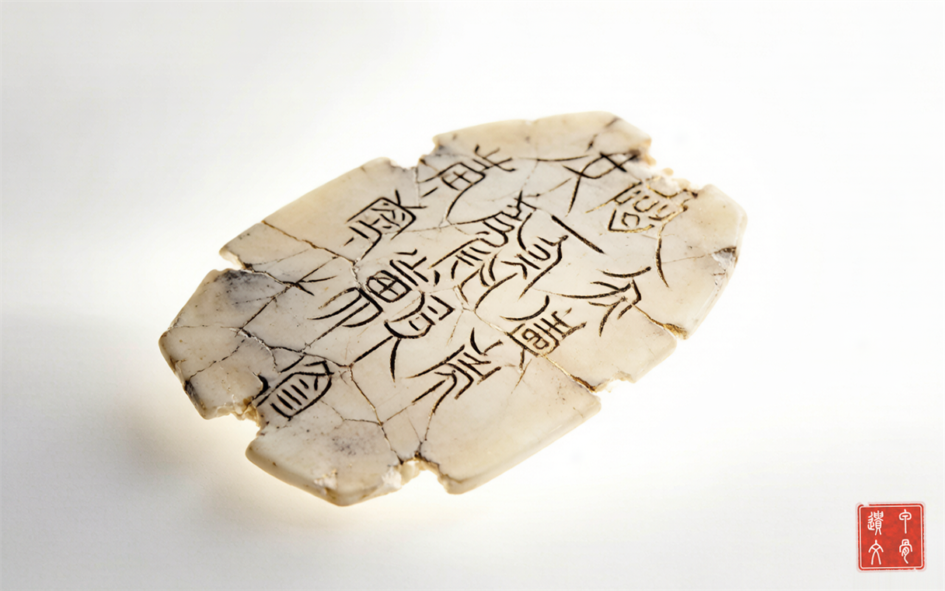
The Short Version: Oracle bone script (甲骨文, jiǎgǔwén) is China\'s earliest mature writing system, carved into turtle shells and animal bones about 3,300 years ago. It wasn\'t discovered by archaeologists — it was found by a malaria patient in a medicine shop. Oracle bones record the questions Shang Dynasty kings asked the gods: Will it rain? Will we win the war? Will my toothache get better? Every character is a picture. And unlike every other ancient script, it never died — the characters on your screen today are its direct descendants.
In 1899, a Chinese official named Wang Yirong caught malaria. His doctor prescribed a traditional remedy that included \"dragon bones\" — fragments of ancient animal bones sold as medicine. Wang looked closely at the bones and noticed something. The scratches on them weren\'t cracks. They were characters.
1. The Archaeological Discovery in a Medicine Shop
Beijing, 1899. Wang Yirong, a high-ranking Qing Dynasty official and scholar of ancient bronzes, fell ill with malaria. In those days, the treatment included a traditional medicine called \"dragon bones\" (龙骨, lónggǔ) — supposedly fossilized animal bones, ground into powder.
Wang was a man of letters. When his family brought the medicine home, he noticed that the bone fragments had regular markings — not natural cracks, but deliberate carvings. His trained eye recognized something: these symbols resembled known bronze inscriptions, but were older, more primitive.
He immediately sent someone to buy every piece of \"dragon bone\" the medicine shop had. He concluded: this was a writing system older than anything previously documented.
This discovery rewrote Chinese history. Until then, Western scholars considered the Shang Dynasty (c. 1600–1046 BCE) semi-mythical — a legend without written evidence. Oracle bone script pushed China\'s documented history back to 1300 BCE. Overnight, three centuries of \"myth\" became verified history.
Wang didn\'t live to continue his research. In 1900, the Eight-Nation Alliance invaded Beijing. Wang, refusing to flee, drowned himself in a well. His collection eventually passed to Liu E, author of The Travels of Lao Can, who published the first catalog of oracle bone rubbings in 1903: Tieyun Cangjia.
\"There are carved characters on the turtle shells. Examining them closely, they are neither seal script nor Zhou bronze script — they seem to be characters, yet not characters.\" — Liu E, preface to Tieyun Cangjia (1903)
2. The Shang King\'s Question List
What is oracle bone script? It\'s the record of questions Shang Dynasty kings asked the gods.
The Shang believed that everything — weather, war, harvest, disease, childbirth — was controlled by spirits. Anything uncertain could be consulted through divination. The method: take a turtle plastron or ox scapula, drill small pits into it, and apply heat. The bone cracks. The crack makes a \"pu\" sound — and the Chinese word for divination, 卜 (bǔ), imitates that sound. The shape and direction of the crack = the god\'s answer.
After the divination, the officiant (called a 贞人, zhēnrén) carved the question and answer onto the bone. Sometimes they added the actual outcome later: \"Divined: it will rain. It did rain.\" Or: \"Divined: we will win. We lost.\"
This created a staggering archive: a Shang king\'s daily question list from three thousand years ago, preserved intact.
- c. 1600 BCE — Shang Dynasty Founded: The Shang establish their capital and begin early divination practices.
- c. 1300 BCE — Capital Moves to Yin: King Pan Geng moves the capital to Yin (modern Anyang, Henan). Oracle bone script enters its golden age.
- c. 1046 BCE — Shang Falls: King Wu of Zhou conquers the Shang. The oracle bone divination system dies with the dynasty. Bones are buried and sleep for 3,000 years.
- 1899 — Wang Yirong\'s Discovery: \"Dragon bones\" in a medicine shop are identified as ancient writing. China\'s documented history extends back 300 years.
- 1928 — Scientific Excavation Begins: The Academia Sinica begins formal archaeological excavation at Yinxu in Anyang. Over 150,000 oracle bone fragments are recovered.
- 2017 — UNESCO Memory of the World: Oracle bone script is inscribed on UNESCO\'s Memory of the World Register, recognized as a heritage of humanity.
3. What Did the Shang King Ask About?
This is the most fascinating part of oracle bones — through these carvings, you can see what a king thought about every day, three thousand years ago.
Weather: \"Divined on day jiazi: will it rain?\" The most common question. The Shang were an agricultural society — weather was survival.
War: \"The Tufang are attacking our eastern border — can we repel them?\" The Shang fought wars almost every year.
Toothache: \"Divined: the king\'s tooth hurts — is it the spirit of Chiyou?\" The Shang believed illness was caused by vengeful spirits. Even a toothache required asking which ghost was responsible.
Childbirth: \"Lady Hao will give birth — will it go well?\" Lady Hao (妇好) was the wife of King Wu Ding, and the first recorded female general in Chinese history. Her divinations are unusually numerous — because Wu Ding cared about her deeply.
Dreams: \"The king dreamed of a white ox — is there disaster?\" The Shang took dreams seriously, interpreting them as signals from the spirit world.
Why This Matters: Read enough of these, and you realize: people three thousand years ago were no different from us. They worried about rain, feared war, wanted to know why their tooth hurt, and anxiously waited to hear if their wife and baby were safe. Oracle bone script isn\'t a cold archaeological artifact — it\'s a diary carved in fear and hope.
4. Every Character Is a Picture
The most striking feature of oracle bone script is that it\'s drawn. Every character is a simple line drawing — you don\'t need to read Chinese to \"see\" what it represents.
- 日 (rì) — Sun: A circle with a dot inside. The dot represents sunspots or radiance.
- 月 (yuè) — Moon: A crescent. A full moon would look like the sun, so they drew a crescent to distinguish.
- 人 (rén) — Person: A standing figure in profile, arms at sides. The simplest human drawing possible.
- 山 (shān) — Mountain: Three peaks. Almost identical to the modern character 山.
- 水 (shuǐ) — Water: A curving line with drops on either side. A flowing river.
- 虎 (hǔ) — Tiger: A tiger in profile with open jaws and stripe markings on the body.
Notice something? The character for \"sun\" — 3,000 years later — is still a circle with a line through it. \"Mountain\" is still three peaks. \"Person\" is still a standing figure in profile.
This is the unique genetic code of Chinese characters: it never broke. Egyptian hieroglyphs died. Cuneiform died. Mayan script died. Only oracle bone script survived — from bone to bronze to seal script to clerical script to regular script to the font you\'re reading right now. The \"sun\" (日) you see on your screen today is the same \"sun\" a Shang diviner carved on a turtle shell 3,300 years ago. Same character. Unbroken chain.
5. Oracle Bones in Modern Life
Oracle bone script isn\'t dead. It lives in every character a Chinese person writes today. But in recent years, it\'s taken on new faces — in places you might not expect.
Emoji. In 2017, designers from the China Academy of Art turned oracle bone characters into WeChat stickers. The \"sun\" character smiles, the \"moon\" looks shy, the \"person\" walks. Over a million downloads. A 3,000-year-old writing system became a chat tool for young people.
Type design. Multiple designers are translating oracle bone script into modern typefaces. Foundries like Fangzheng and Hanyi have released oracle bone fonts that designers can use in layouts.
Cultural products. The Palace Museum and National Museum of China have launched oracle bone-themed merchandise — scarves, bookmarks, fridge magnets, phone cases. The \"pictographic\" nature of oracle script makes it naturally suited for visual products.
Education. More and more elementary schools in China are teaching character recognition through oracle bone script — draw a circle with a dot, tell the child \"this is how people drew the sun 3,000 years ago,\" then transition to the modern 日. Children aren\'t memorizing characters — they\'re seeing them.
6. Why Oracle Bones Matter to You
If you have any interest in Chinese culture — whether you\'re Chinese or not — oracle bone script is the deepest yet most accessible entry point you\'ll find.
Most accessible: because it\'s pictures. You don\'t need to read Chinese, don\'t need to know Shang Dynasty history. Just look at the shapes. \"Sun\" is a sun. \"Mountain\" is a mountain. \"Tiger\" is a tiger. Anyone can \"read\" oracle bone script.
Deepest: because behind every character lies three thousand years of human activity. \"Lady Hao will give birth — will it go well?\" — an anxious husband\'s wait, carved in bone three millennia ago. A king with a toothache. A farmer afraid of rain. A general preparing for war. Their fears and hopes were carved into bone, survived three thousand years of burial, and landed in front of your eyes.
Three thousand years ago, someone carved a circle with a dot in the center. Three thousand years later, you see it and know it means \"sun.\" That act of understanding across three millennia — no other writing system in the world can give you that experience.
Coming Soon: The Oracle Bone Collection
We\'re designing a collection of wall art and accessories built on those 3,000-year-old pictures — oracle bone zodiac prints, sun-moon-mountain minimal posters, and custom seal stamps, inspired by original Yinxu oracle fragments and modern minimal aesthetics. Stay tuned.
Keep Reading
- Qixi Festival: The 2,000-Year-Old Chinese Love Story — China\'s oldest love story, written in the stars. Published
- One Character, One Culture: Understanding Zen (禅) — From Indian Buddhism to Japanese aesthetics, one character\'s 1,500-year journey. Coming soon
- Mid-Autumn Festival: Why the Chinese See a Rabbit in the Moon — Another ancient sky-watching tradition, this time on the moon. Coming soon
The classical texts referenced — the oracle bone inscriptions of Yinxu — are in the public domain; UNESCO-listed heritage of humanity.