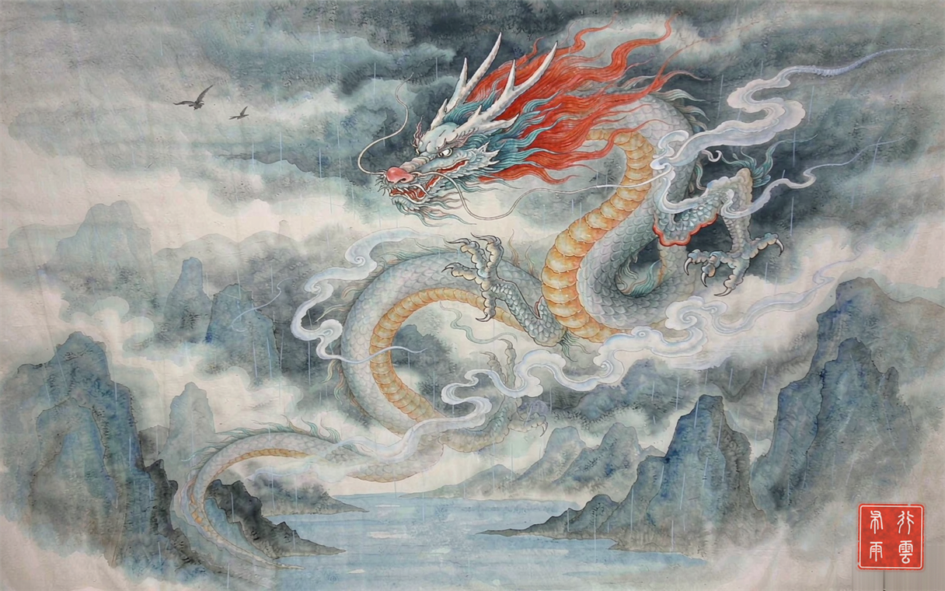
Ask someone raised on European stories what a dragon is, and the answer comes in a tidy package: it flies, it breathes fire, it sleeps on a pile of stolen gold, and sooner or later a hero arrives to kill it and claim the hoard. Ask the same question in China, and the package falls apart. The Chinese dragon — the loong (often rendered simply as “dragon” in English) — does not kidnap princesses. It decides when the rain comes. It does not get slain by heroes; it gets temples, offerings, and holidays named after it. And it does not lurk in a cave at the edge of the map. It lives in every river, every well, every pond — often just down the road.
The loong may be the most misunderstood famous animal on earth, and the gap between the two dragons says a lot about the two cultures that imagined them.
A creature stitched together from nine animals
Start with the body, because the body is the first surprise. The loong has no wings — yet it flies. Classical descriptions read like an animal assembled from the best parts of nine others: the antlers of a deer, the head of a camel, the eyes of a hare, the neck of a snake, the belly of a giant clam, the scales of a carp, the claws of an eagle, the paws of a tiger, the ears of an ox. A Han-dynasty scholar named Wang Fu catalogued these “nine resemblances,” and artists have been arguing about the proportions ever since.
The second-century dictionary gives the characteristically Chinese summary:
The long is the chief of scaled creatures. It can be dark and it can be bright, it can be thin and it can be thick, it can be short and it can be long. At the spring equinox it ascends to the sky; at the autumn equinox it dives into the deep.
— Xu Shen, Shuowen Jiezi (translation ours)
Notice what is missing from that entry: fire. The loong’s element is not flame but water — clouds, mist, rivers, rain. Where the Western dragon is a creature of the underground and the dead end of the world, the loong is a creature of the sky and the harvest.
The oldest dragon is a scratch on bone
The dragon is old enough that nobody knows exactly where it came from. Archaeologists have dug up jade dragon figurines more than five thousand years old — a coiled, C-shaped piece of polished jade from northeastern China is often called “the first dragon of China,” and it predates writing by a very long margin.
Once writing does appear, the dragon is already there. Among the divination records carved on tortoise shells and ox bones three thousand years ago — the oldest substantial writing in Chinese, which we covered in a piece on oracle bone script — the character for long shows up as a recognizable picture of a big-headed, curving creature. Shang-dynasty kings carved questions about rain beside it: Will it rain today? Will the rain be enough for the millet? The dragon and the weather forecast have been colleagues ever since.
Dragon Kings: the bureaucracy of rain
By imperial times the dragon had been organized — thoroughly, and in the Chinese way, which means it got a civil service. There were four great Dragon Kings (Longwang), one for each of the four seas that bordered the world. Below them, the system branched down to the local level: every river had its dragon, every lake, every well, every spring. If you wanted rain, you did not petition the sky in general. You petitioned the dragon who managed your particular water.
That meant village life was full of dragons. Dragon King temples stood near rivers and wells; farmers brought offerings in drought years, and — tradition records this without embarrassment — occasionally gave the local dragon statue a public scolding when the rain still refused to come. A god who controlled the harvest was a god worth negotiating with. The Dragon Kings also appear in the classic novels as dignified, slightly put-upon underwater administrators, keeping ledgers of rain and policing their rivers, with the occasional troublesome hero barging in to borrow a treasure.
The logic underneath is easy to state and easy to respect: in a civilization of farmers, the single most important supernatural question was not “who rules the underworld” but “will the rain come on time.” The culture gave that question a face, antlers, and a temper.
The emperor’s dragon
For most of imperial history, though, ordinary people were not allowed to use the best dragons. The five-clawed dragon — the most powerful kind — became the private property of the emperor. His seat was the Dragon Throne; his robes were embroidered with dragons; his face was, by courtly convention, described in dragon terms. Princes and high officials had to make do with dragons of four or three claws. Wearing the wrong number of claws was not a fashion mistake. It could be read as ambition, and ambition of that kind shortened lives.
The dragon’s royal résumé is long: emperors traced legendary ancestresses to dragons, dated their reigns by dragon omens, and stamped state ceremony with dragon imagery for two thousand years. What is interesting is what happened after all of that ended. When the empire was gone, the dragon did not fall with it. It simply changed employers — from one family’s throne to everyone’s heritage.
The dragon today
That is the real difference between the two dragons. The Western dragon survives mainly as an adversary, a thing for stories to overcome. The loong came down off the throne and moved into the neighborhood, and nobody kills it.
It shows up at every festival: the dragon dance, where a team of dancers carries the long silk body on poles and makes it swim through the air — the same sinuous motion that has defined the creature for millennia. It shows up on the water in dragon boats, racing hulls carved with dragon heads, powered by drumbeats and dozens of paddles. It shows up in language: a parent who “hopes the child becomes a dragon” (wangzi chenglong) is hoping the child becomes extraordinary, which tells you the dragon is the animal you want to be compared to. Across Chinese communities worldwide, people describe themselves as descendants of the dragon — a lineage nobody needs to prove, because it was never about genealogy. It is about belonging to a story this old.
Festival season is the best time to meet the loong in person. The Mid-Autumn Festival guide walks through the night when lanterns and family dinners fill the streets, and the myths come out with the mooncakes.
Keep reading: Chang’e: The Goddess Who Lives on the Moon tells the sky’s other great Chinese story, and the Mid-Autumn Festival guide shows where the whole mythology comes out to be celebrated.