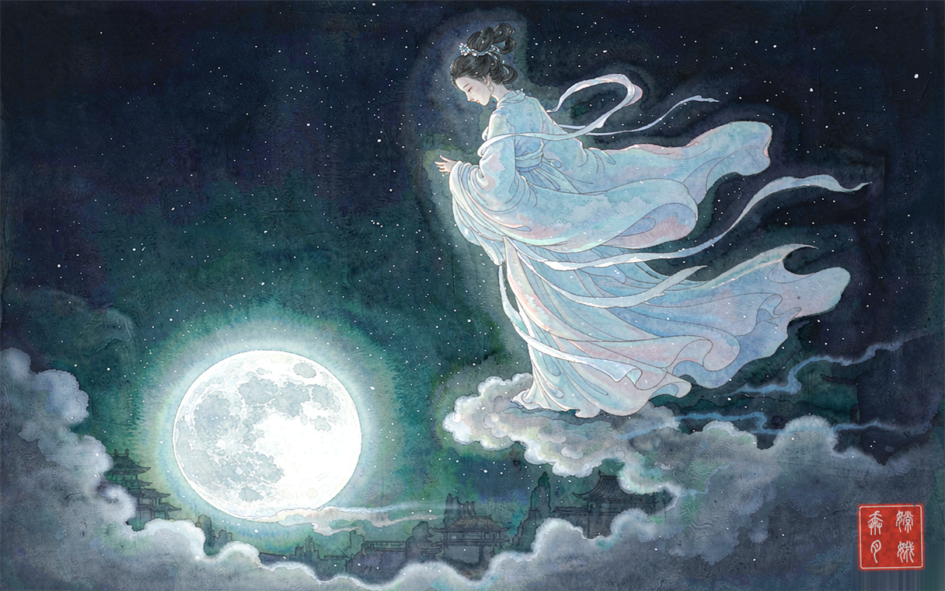
Look at the full moon on the night of the Mid-Autumn Festival and, in the Western tradition, you might see a man’s face. In China, the moon has never been a man.
It is a palace — cold, luminous, and far away — and it belongs to a woman named Chang’e (the Moon Goddess). For at least two thousand years, Chinese children have been told how she got there: a heroic archer, a pill of immortality, a flight that could not be taken back. It is a story about the price of leaving, which is exactly why it is told on the one night each year when everyone is supposed to be home.
First, the archer
To understand Chang’e, you need her husband: Hou Yi, the divine archer.
In the oldest telling, ten suns rose into the sky at once — not ten reflections, but ten real suns, children of the Di Jun, the High God. Together they scorched the earth. Crops burned, rivers dried, and monsters came down from the wilderness to feed on the desperate. The world was a day or two from ending.
So the archer was sent up. Hou Yi drew his great red bow and shot down nine of the ten suns, one by one, leaving a single sun to make its appointed journey across the sky. The earth recovered. He became the greatest hero of his age — celebrated, feared, and, as the story goes, surrounded by people who wanted what he had.
The elixir
Heroism has a shelf life, and heroes die. That fact bothered Hou Yi enough that he traveled west, beyond the desert, to the palace of the Queen Mother of the West — an ancient, enigmatic goddess who kept the drug of immortality in her keeping. She granted him a single dose: enough for one person to live forever.
And here the story splits, because the oldest sources disagree — and Chinese tradition is comfortable letting them.
The version recorded in the Huainanzi, a Han-dynasty encyclopedia from the 2nd century BC, is blunt:
Yi had asked the Queen Mother of the West for the elixir of immortality. Heng’e stole it and fled with it to the moon.
— the Huainanzi (translation ours)
Heng’e — the goddess’s original name — stole her husband’s elixir and flew up, past the towers of the wind, to the only place no one could follow her: the moon.
A later version, still widely told, softens the theft. In this telling, a treacherous student of Hou Yi’s — Feng Meng — broke into the house with a sword while the archer was out hunting, demanding the elixir. Knowing she could not overpower him and unwilling to let a villain live forever, Chang’e made her choice in a heartbeat: she swallowed the pill herself. Her body grew light, rose through the roof, and kept rising — all the way to the nearest kingdom out of a murderer’s reach.
Either way — thief or guardian, vanity or sacrifice — the result is the same, and it is the reason this is a story about regret: Chang’e arrives in the sky alone. Immortality, it turns out, is the one gift that cannot be shared with the person you left behind.
A small detail that historians love: her name was not always Chang’e. The oldest texts call her Heng’e. It was changed to avoid the taboo on the personal name of Emperor Liu Heng of Han (reigned 180–157 BC) — a reminder that even the moon’s population answers, occasionally, to court protocol.
The palace of vast cold
The moon of Chinese legend is not a desert rock. It is the Guanghan Gong — the “Palace of Vast Cold” — a white, silent mansion with a cassia tree at its gate. Chang’e is its only resident, though not quite its only inhabitant:
- The Jade Rabbit (Yutu), her constant companion, stands under the cassia tree pounding the elixir of immortality in a mortar — the drug that could, in theory, let someone else join her. Squint at the full moon’s dark patches and you may see the rabbit yourself; across East Asia, people have seen it for centuries.
- Wu Gang, a woodcutter exiled to the moon for a lapse in his studies, was sentenced to fell the cassia tree. The tree is immortal: every axe stroke closes behind the blade. His labor is eternal and unfinishable — the Chinese Sisyphus, standing just outside the goddess’s door.
- The toad. One Han-dynasty source, the Lingxian, offers the most haunting variant of all: that Chang’e did not merely arrive on the moon, but was transformed on arrival — into a toad, the moon’s earliest known animal emblem. Later generations found this too cruel and promoted her back to goddess. Both versions survive in the written record.
As for Chang’e’s husband, the tradition says Hou Yi set out her favorite fruits and cakes under the full moon and pressed the incense she once burned. Neighbors followed his example — which, one version of the legend claims, is how the Mid-Autumn offering table began.
What the poets did with her
Chang’e became the great mirror of Chinese poetry: anyone who has ever chosen work over home, ambition over love, or distance over presence, finds their own face in hers.
The Tang poet Li Shangyin (c. 813–858) put the whole story in fourteen characters:
Chang’e must regret the elixir she stole — night after night, a heart of blue sea and dark sky.
— Li Shangyin, “Chang’e” (translation ours)
And the most beloved poem for the festival itself is Su Shi’s Song-dynasty lyric Shui Diao Ge Tou, written in 1076 during the Mid-Autumn Festival while the author, drunk and homesick, thought of a brother he had not seen in years. It opens with a question addressed directly to the goddess’s sky:
Bright moon, when did you first appear? I raise my cup and ask the clear sky — and wonder, in those palaces on high, what year it is tonight.
— Su Shi, “Prelude to Water Melody” (translation ours)
Its final lines — “May we live long; though a thousand miles apart, we share the same graceful moon” — have been recited at Mid-Autumn tables for nearly a thousand years. They contain the festival’s entire logic: you cannot always be with the people you love, but the moon is the one thing you still share.
From myth to the far side of the moon
Here is where an old story turns quietly modern. In Chinese folklore, virtually everything that has ever reached the moon ends up in the Chang’e legend — and in the last two decades, that has come to include spacecraft.
China’s lunar exploration program is named the Chang’e program. Its relay satellite, which hovers beyond the moon to pass signals back to Earth, is named Queqiao — the “Magpie Bridge” from the legend of the Cowherd and the Weaver Girl, the sky-crossing bridge of another mythic reunion. The rover that carried China’s first lander to the lunar surface carried, as a passenger, a small greenhouse that sprouted the first plant ever grown on the moon: a cotton seedling, briefly alive in the Vast Cold Palace.
The names are not decoration. They are the same continuity this site writes about — a civilization filing its newest achievements into a mythology two thousand years old, so that a lunar lander and a Han-dynasty goddess share one shelf of the imagination. When the program’s landers touched down on the moon’s far side — a first in human history — the press releases were read by an audience that had known the moon’s most famous resident since childhood.
Why one goddess carries a whole festival
Every culture separates from the people it loves; not every culture gives the separation a goddess.
That is Chang’e’s real function. The Mid-Autumn Festival is a reunion holiday, but reunions are only poignant because absence exists — and Chang’e is absence, personified and put somewhere useful: high, visible, and shared. She is the reason a Chinese family can stand in a courtyard, look at the moon, and feel that the relative who could not come home is, in some literal sense, in the same place they are looking.
The oldest versions of the legend call her flight a theft. The later versions call it a sacrifice. The festival itself — the way it is actually lived, with cakes and lanterns and children on rooftops — suggests a third reading: she is simply the first one who showed that “apart” and “together” can be true at the same time.
That is a considerable amount of work for one moon, but then, she has been up there a long time.
Keep reading: Mid-Autumn Festival 2026: A Complete Guide — what the festival is and how to join in this Friday. And next week on Loremark: her only companion, the Jade Rabbit.