Every September, one argument reliably returns to the Chinese internet, right on schedule with the moon: is the five-kernel mooncake (wuren) a classic or an abomination?
The debate is real, loud, and increasingly tongue-in-cheek — defenders of the chewy nut-and-seed filling versus a generation raised on snow skin and lava custard. It is, you might say, the most delicious civil disagreement in East Asia. But it is also proof of something remarkable: a pastry with a written paper trail over a thousand years long still commands this much feeling.
This is the history of the mooncake — where it came from, what it meant, and how a sacrificial offering became the most argued-about baked good on earth.
Before the mooncake: round cakes for a round moon
The Mid-Autumn Festival is ancient; the mooncake as we know it is younger, assembled over centuries from older customs.
The logic behind it, however, is as old as the festival itself. Since the Zhou dynasty (c. 1046–256 BC), the autumn moon had been an object of formal sacrifice — and sacrificial food had to be round, echoing the full moon it honored. Early sources describe round cakes and fruits laid out on the offering table. The cake and the moon were designed to rhyme.
By the Tang dynasty (618–907), the round pastry had a street presence. One popular legend — and it should be enjoyed as a legend — places the naming of the mooncake with Yang Guifei, the celebrated consort of Emperor Xuanzong. Mid-autumn moon-viewing at the palace, the story goes, a tray of “hu bing” (胡饼, “foreign cakes”) was served; finding the name unlovely, she gazed at the full moon and rechristened the pastry yuebing — “moon cake.” Charming, unverifiable, and still retold every September: exactly the kind of story a national pastry accumulates.
What is on firmer documentary ground is the Song dynasty (960–1279). A city encyclopedia of Hangzhou, the Mengliang Lu, lists yuebing among the capital’s everyday snacks — though scholars point out that at this stage it was still a general pastry, not yet the festival’s exclusive property. Around the same era, a verse attributed to Su Shi gives the best one-line description of the prototype:
A small cake like biting into the moon — within, the flakiness of pastry and the sweetness of syrup.
— attributed to Su Shi (translation ours)
Whether Su Shi was describing a true ancestor of the mooncake or just an excellent snack is debated. Poets, as usual, refused to be footnoted.
The Ming dynasty: the cake becomes the festival
The mooncake’s decisive promotion happened in the Ming dynasty (1368–1644), when the festival and the pastry finally locked together. A celebrated Ming guide to Beijing customs, the Dijing Jingwulüe (1635), records the mid-autumn altar with a precision you can picture:
On the fifteenth of the eighth month, the moon is worshipped; the fruit and cake on the offering table must be round.
— the Dijing Jingwulüe (translation ours)
Roundness was now doctrine. The same book notes festival cakes so large — “a foot or more across” — that a whole family had to share one, each member receiving an equal wedge. Here you can see the custom that survives intact today: the mooncake is cut, never wolfed, because the cutting is the point. Equal slices for equal members of a family, including those absent. The pastry is a diagram of the household.
The Ming era also supplies the mooncake’s most dramatic legend. In this version — told with knowing smiles and zero scholarly endorsement — the upcoming uprising that would end Mongol rule planned for the mid-autumn night needed a way to coordinate cells across a policed countryside. The message traveled hidden inside mooncakes. Whether or not a pastry ever carried a battle plan, the story welded the mooncake to the idea of secretly shared meaning — a cake you give someone says something.
Beijing, 1900: the pastry goes professional
By the Qing dynasty (1644–1912), mooncake quality had become serious civic business. The Yanjing Suishiji, an almanac of Beijing’s festival year, hands down the era’s verdict with critic-like economy:
In the mid-autumn mooncake trade, the shop Zhimeizhai, outside the Qianmen gate, ranks first in the capital.
— the Yanjing Suishiji (translation ours)
Named-bakery rivalry, gift-box inflation, seasonal queues: the modern mooncake economy is not so modern after all.
The mold: where the craft hides
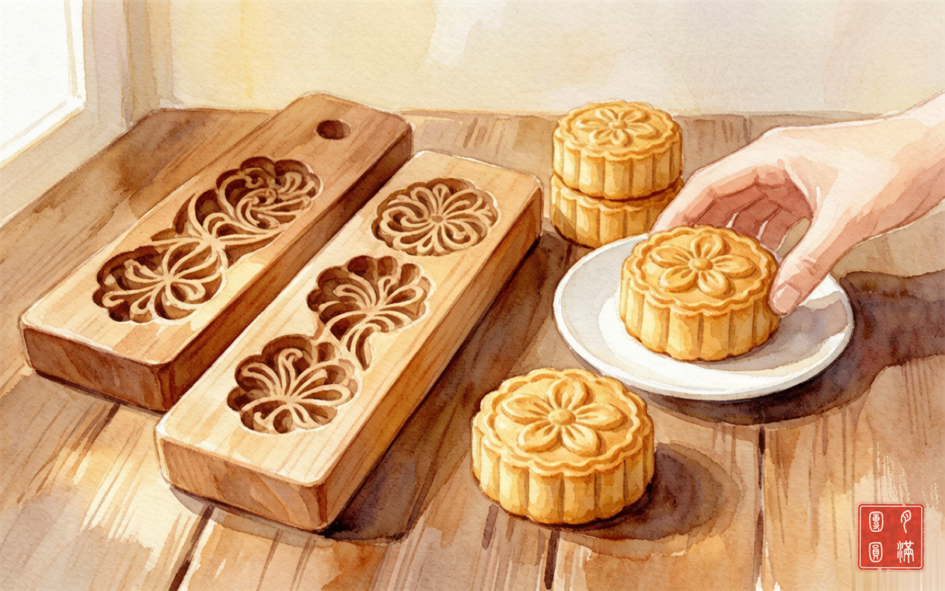
The mooncake’s most distinctive feature is not taste but topography — the deep, crisp relief on top: flowers, lucky characters, the bakery’s mark. That comes from the wooden mold (bingmo), a carved block into which the filled dough is pressed and then knocked free with a practiced tap.
Carving a good mold is a genuine woodworking craft: the pattern must release cleanly, and the cuts must stay legible after baking and the glossy egg-wash that turns the crust mahogany. Regional carving styles differ — southern molds favor dense floral borders, northern ones bolder single motifs — and old molds are now collector’s pieces, their worn patterns often older than any bakery still trading. It is the quietest of China’s traditional crafts, hiding in plain sight on every festival table.
The fillings: a thousand-year argument
The core roster has been stable for generations:
- Lotus seed paste, golden and smooth — the Cantonese gold standard, often crowned with a salted duck egg yolk whose round, briny center stands in for the moon.
- Red bean and mung bean pastes — the homestyle classics.
- Five kernels (wuren) — walnut, almond, melon seed, sesame, peanut bound in syrup. Object of the annual internet war. Its defenders note it is the oldest filling logic, a map of the autumn harvest in one slice; its critics note, fairly, that bad wuren is a genuinely chewy punishment.
- Ham and honey (Yunnan) — sweet-salty, pork-forward, fiercely defended by its home province.
- Snow skin — the modern rebel: unbaked, chilled, soft-skinned, popularized from Hong Kong in recent decades and now the youth default, in flavors from mango to custard to ice cream.
The gift economy around the pastry — elaborate boxes exchanged between families, firms, and in-laws — has cycled through its own eras of excess and restraint, and is itself a small anthropology of Chinese social obligation. The mooncake, as always, says something; this time the message is about the giver.
Why the shape will never change
Flavors will keep mutating — that part of the mooncake is a fashion cycle. The form, though, is fixed by what the cake means.
A mooncake is round because the mid-autumn moon is round; it is cut into equal wedges because reunion means everyone, present or absent; and it is given, not merely eaten, because for a thousand years it has served as the edible form of the sentence I wish we were under the same moon. The five-kernel faction will keep fighting the custard faction every September. Both sides are baking the same circle.
Planning to try mooncakes this season? Start with Mid-Autumn Festival 2026: A Complete Guide — what to buy, how to serve it, and what else the festival involves. And for the legends printed on those gift boxes, meet Chang’e, the Goddess Who Lives on the Moon.