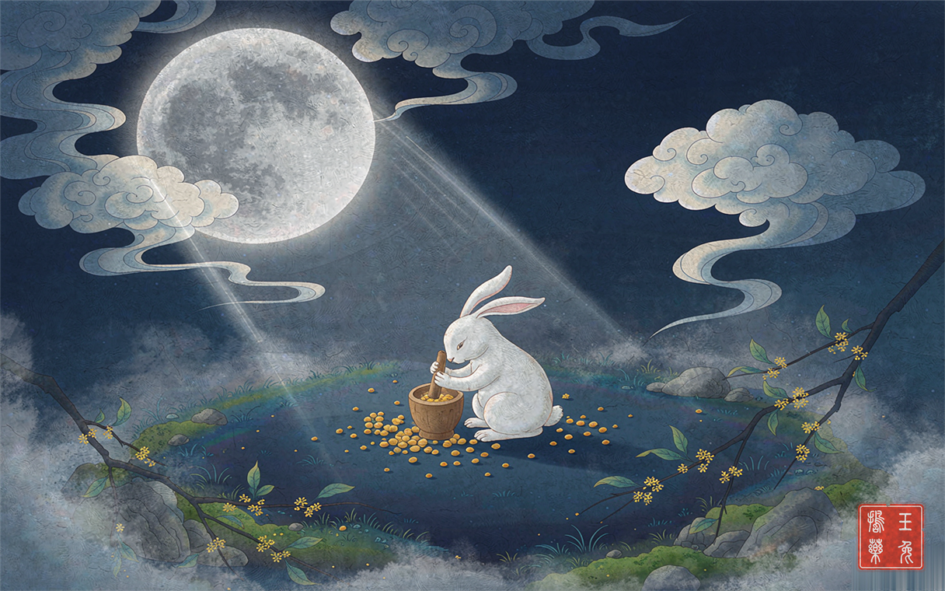
Ask a Western child to look at the full moon and find a face, and they will trace the craters into the outline of a man. Ask a child in China, and you will get a different answer: that is not a face up there. It is a rabbit — white, upright, and busy. For some two thousand years it has knelt in the moonlight with a mortar and pestle, pounding the ingredients of immortality, and it has never once stopped.
The rabbit is not a side character in Chinese myth. It is the moon’s second resident, the constant companion of Chang’e, the Moon Goddess, and one of the most quietly persistent images in East Asian culture — one that modern China respects enough to name its lunar rovers after.
What the rabbit is doing up there
The classic job description comes from a third-century poet. Fu Xuan, writing in the Western Jin dynasty, put the whole scene in a single question and answer:
What is in the moon? A white rabbit, pounding the elixir.
— Fu Xuan, “Ni Tianwen” (translation ours)
What it pounds varies by teller: the elixir of immortality, the ingredients of medicine, or simply the herbs of long life. In the oldest images — Han-dynasty tomb murals and carved stone slabs from roughly two thousand years ago — white rabbits kneel in rows beside the Queen Mother of the West, the enigmatic goddess who kept the drug of immortality in her keeping, pounding elixir for her alone. The same goddess, you may recall, once sold a certain pill to an archer named Hou Yi.
So in the earliest stratum of the legend, the rabbit is the moon’s pharmacist: a creature of the goddess’s court, entrusted with the single most valuable substance in the cosmos. The image stuck. Poetry of the Tang and Song dynasties treats the sound of the rabbit’s pestle as a regular feature of moonlight — poets lying awake at night, hearing (imagining) the soft tok, tok from the sky.
How the rabbit got there
Chinese tradition is comfortable carrying several origin stories at once, and the rabbit has at least three.
The sacrifice. The most moving version came north with Buddhist storytelling from India. In this tale, an old man collapses in the forest, dying of hunger. A fox brings fish; a monkey brings fruit; the rabbit, able to offer nothing but itself, rolls into the fire to become the meal. The old man reveals himself as the Lord of Heaven — the sacrifice was a test — and, moved by the rabbit’s giving, sets its image upon the moon for all to see. In Sanskrit tradition the moon itself is sometimes called the one marked with the hare, which is how scholars know the story traveled: the Chinese rabbit arrived carrying an Indian passport.
The companion. The version most children hear today ties the rabbit directly to Chang’e. When she swallowed the elixir and fled to the moon, the rabbit — her pet, her servant, or simply the only one loyal enough to follow — went with her. It pounds the elixir still, in one poignant reading, trying to cook up a dose strong enough to buy her a return ticket.
The alchemist. And then there is the oldest reading, the one the Han tombs tell: the rabbit never came from anywhere. It was always there, an attendant of the Queen Mother of the West, doing pharmaceutical work at the edge of the sky. Chang’e moved in later; the rabbit was already on staff.
One rabbit, three countries
Look at the same dark patches of moon across East Asia and the rabbit stays, but the job changes — a small natural experiment in how one image adapts to local appetites:
- China: the rabbit pounds the elixir of immortality. The moon rabbit is a creature of medicine and long life.
- Japan: the rabbit pounds mochi — sticky rice cakes, pounded with giant mallets exactly as the moon rabbit pounds them. The animal in the moon is a chef.
- Korea: the rabbit pounds rice to make tteok, rice cakes that appear at every celebration.
Same silhouette, same pestle, different mortar. The rabbit tells you something honest about each culture’s idea of the good life: China dreamt of eternity, Japan of dinner, Korea of festival. All three agree on the essential point — something diligent and white lives up there, and it works while the rest of the sky sleeps.
Where to look
On the next clear full moon — and there is a notably good one coming this fall — squint at the upper-left of the disk (from the Northern Hemisphere). The dark grey patches, which astronomers call maria, are ancient solidified lava plains; to the untutored and wonderfully persistent human eye, they are a rabbit standing on its hind legs before a mortar, or sometimes a rabbit with the mortar strapped to its middle. Our complete Mid-Autumn Festival guide explains the night itself — the lanterns, the family reunion, and which shapes a culture teaches children to find in the sky.
The Mid-Autumn Festival is the rabbit’s busiest night of the year. Lanterns come rabbit-shaped; mooncakes do too, in some bakeries. Children who hear the story at the festival table will spend the rest of the evening squinting upward, and most of them find it.
From legend to the far side
Here is the part of the story that refuses to stay old. When China launched its first lunar rover in 2013, the public named it — of course — Yutu, the Jade Rabbit. The rover rolled onto the moon’s surface that December, then fell silent after a few months of driving; its instruments kept listening for a while longer, a machine with a myth’s heartbeat.
The sequel has been more durable. Yutu-2, carried to the far side of the moon by the Chang’e 4 mission in 2019, went on to become the longest-working rover in the history of lunar exploration — quietly out-driving every machine the United States or the Soviet Union ever parked there. China files its newest achievements into a two-thousand-year-old mythology, so a robot now does, in fact, what poets always said a rabbit was doing: crossing the moon, patiently, one small job at a time.
The rabbit, meanwhile, has not retired. If you believe the poets, it is still up there on clear nights — mortar steady, pestle falling — pounding out the one medicine nobody has managed to synthesize: the feeling of looking up and knowing exactly what you are looking at.
Keep reading: Mid-Autumn Festival 2026: A Complete Guide explains the festival the rabbit stars in, and the history of the mooncake covers the pastry everyone eats while looking for it.