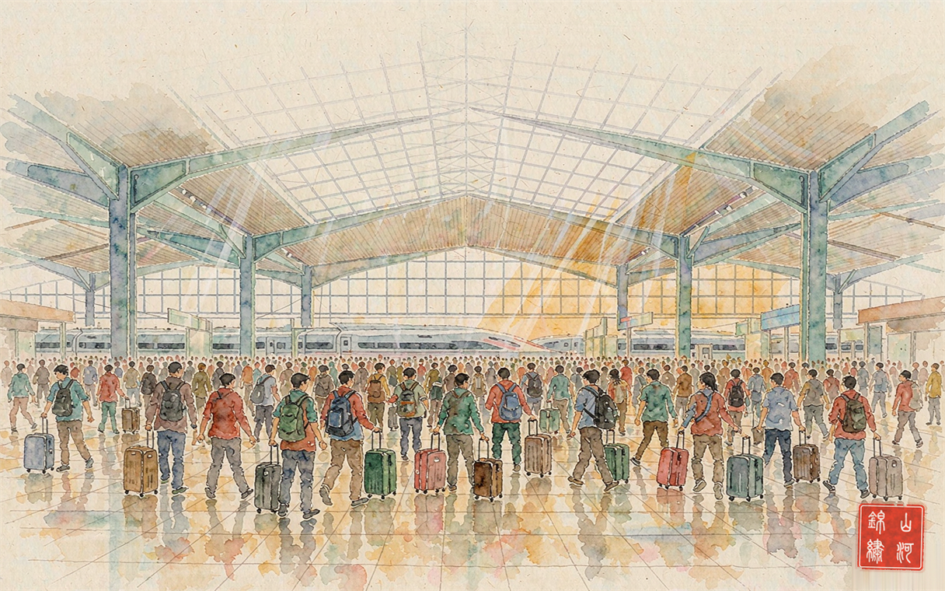
On the first morning of October, something happens that has no real parallel anywhere on Earth. Cinemas fill before noon. The Expressways park themselves full. Long-distance trains sell out their October tickets in seconds, and for the next seven days a significant fraction of the world’s most populous country is in motion — roughly one and a half times the population of the United States, moving mostly at the same time, mostly in the same direction: toward home, toward the mountains, toward the sea.
This is Golden Week — China’s National Day holiday, running October 1 through 7 — and it is the closest thing the modern world has to a national pilgrimage.
What Golden Week actually is
The holiday marks National Day, the anniversary of October 1, 1949. What began as a single commemorative day was stretched, in 1999, into a full seven-day week — not by historical sentiment, but by economics. The week was conceived as a lever for domestic spending: give the workforce a genuine block of days off, the reasoning went, and people will travel, shop, eat out, and buy things they would not buy on an ordinary weekend.
The reasoning held spectacularly. The first Golden Weeks produced travel numbers that stunned planners, and the pattern stuck. (There were once three such weeks each year — Spring Festival, May Day, and National Day — but the May Day week was trimmed back to a single day in 2008, leaving National Day as the great autumn edition.)
In 2026 the timing is unusually generous. Mid-Autumn Festival falls on Friday, September 25, so many workers will bridge the two holidays with a few days of leave and get a stretch of two weeks or more — a “super holiday” that travel agents are already selling hard.
Tiaoxiu: the machine behind the days
To understand Golden Week you need one more word: tiaoxiu (调休) — the reshuffling of rest days.
The trick works like this. The official holiday is only a few days long, but everyone wants a continuous week, so one or two weekend days on either side are declared working days. You work the Saturday before the holiday, rest the week after it, and the calendar comes out even — on paper. In practice this produces the famous Golden Week schedule cards that circulate every September: diagrams of working Saturdays and stacked rest days that look like a puzzle designed by someone with a grudge against weekends.
People complain about tiaoxiu the way people everywhere complain about daylight saving time — loudly, every year, and without expecting it to change. It is the small tax paid for the large luxury of a true seven-day block, and it explains a detail first-time visitors find baffling: the Sunday before Golden Week is a full working day in most offices.
The largest coordinated movement of people
The scale of the week is best told in tickets. On the day October bookings open, the national rail booking system — a single app handling hundreds of millions of users — experiences a demand spike that has become a minor national spectacle in itself. Popular high-speed routes sell out within minutes. Candidates for the hardest ticket of the year include Beijing to Shanghai and anything departing a megacity on the evening of September 30.
By official counts, recent Golden Weeks have logged well over 700 million domestic trips — road, rail, and air combined — across the holiday stretch. For comparison, that is more people moving than live in the European Union, spread over roughly one week.
The roads get their share. Tolls are waived for passenger cars during the holiday — a genuine saving, and the reason the expressways out of every major city produce their annual genre of photographs: eight lanes of brake lights stretching to the horizon, families playing badminton on the shoulder of a highway that has become, briefly, the world’s largest parking lot.
What the week buys
For the tourism economy, Golden Week is the harvest. Scenic areas — the Great Wall, the Forbidden City, the stone forests and karst rivers of the south — log visitor numbers in a single week that some countries manage in a year. Hotels in popular towns double or triple their rates and still fill. Restaurants run out of the good stuff by mid-afternoon; the humblest noodle shop on a mountain trail can have its best week of the year.
For families, it is something else again: one of the few times in the year when three generations are genuinely free at the same time. A great deal of Golden Week travel is not sightseeing at all — it is the long-delayed visit to grandparents, the trip parents promised their children in June, the wedding (early October is prime wedding season; banquet halls book out months ahead).
And for the roughly one billion people who stay put, there is a quieter pleasure: the megacities empty out. Shanghai and Beijing in the first week of October are strange, restful places — traffic light, metros seated, the usual roar turned down to a hum. Locals who stay home call it the best week of the year to have the city to yourself.
If you are traveling during Golden Week
Visitors are not excluded from any of this — they are simply dropped into the deep end. A few field-tested adjustments:
- Book everything early. Trains open for booking roughly two weeks out, and the good trains go in hours. Hotels follow the same curve.
- Go at opening time. The Forbidden City at 8:30 a.m. is a park; at 11 a.m. it is a river. The difference between a good and a bad Golden Week visit is usually just the alarm clock.
- Pick second cities. Chengdu is packed; Leshan, two hours away, is merely busy. The tier-two cities offer the same food culture with a fraction of the crush.
- Or lean into the empty metropolis. Some of the best Golden Week experiences are urban and accidental: a quiet Bund, a bookstore with room to browse, a proper tea session in a teahouse that normally has a line out the door.
Golden Week is many things — logistics marvel, economic engine, annual complaint, family ritual. Mostly, though, it is the modern form of an old Chinese conviction: that however busy the year has been, there is one week when the proper thing to do is go somewhere, together, and eat well when you arrive.
Keep reading: Mid-Autumn Festival 2026: A Complete Guide covers the holiday that opens the season, and the mooncake’s thousand-year history explains the pastry everyone packs for the train.